
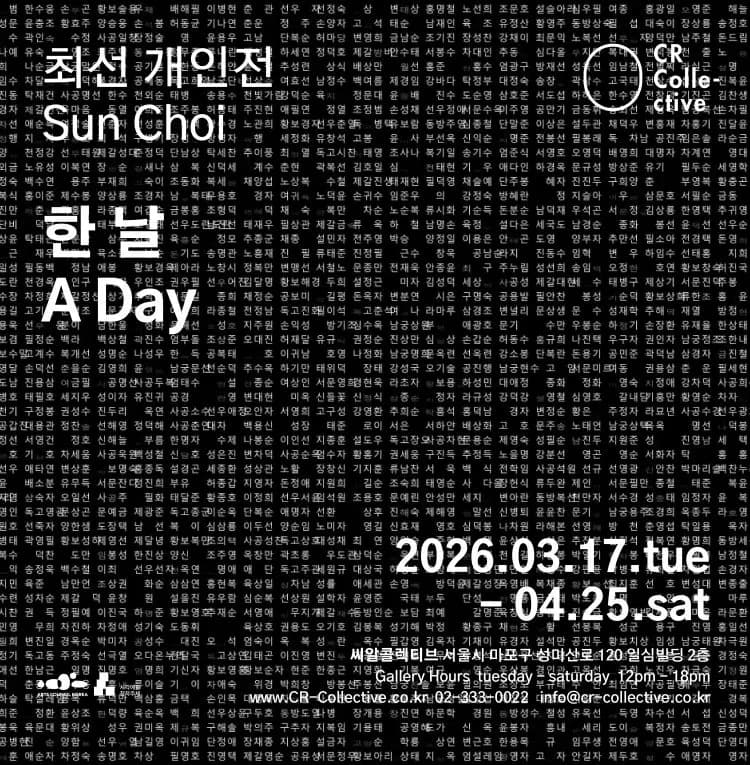
최선 개인전《한 날 A Day》
씨알콜렉티브
2026.03.17(화) - 04.25(토)
이 이벤트는은 휴일입니다
※상세·최신 정보는 이벤트의 공식 사이트를 확인해 주세요.
MAP
SHARE

이벤트 정보 복사하기복사
최선의 죄의식은 어디에서 오는가. 그것은 가해자의 기억에서 비롯된 것인가, 아니면 여전히 세계 곳곳에서 반복되는 전쟁과 폭력 속에서 자신은 안전한 위치에 있다는 사실을 인지하는 순간 발생하는 윤리적 균열에서 비롯되는 것인가.
최선의 개인전 《한 날 A Day》은 1950년 7월 노근리에서 단 하루 동안 집중적으로 벌어진 민간인 학살의 시간성을 호출한다. 작가는 현장 외벽에 남아 있는 다수의 총탄 흔적을 단지 과거 사건의 증거로 보지 않는다. 그것은 시간이 응고된 표면이며, 폭력의 흔적이다. 전시의 제목 ‘한 날’은 과거의 특정 시점을 가리키면서도, 오늘의 하루 역시 언제든 폭력의 시간으로 전환될 수 있음을 암시한다.
작품 〈한 날〉에서 총탄의 흔적은 실제 천을 불로 태워 만든 동그란 구멍으로 재현된다. 이 평면의 구멍은 폭력의 상흔을 묘사하기보다 총탄이 통과한 자리를 물질적으로 제시한다. 불에 의해 생성된 원형의 결손은 보호막이자 지지체로서의 평면이 관통되었음을 드러내며, 동시에 내외부의 경계가 무너진 상태를 함축한다. 이때 구멍은 단순한 이미지가 아니라 폭력의 흔적이 남은 자리이며, 인간 생명의 존엄이 위협받는 순간을 드러내는 결손의 표면이다.
노근리의 ‘한 날’은 이후 함초 페인팅 〈웅덩이〉로 이어진다. 염생식물인 함초가 고염 환경에 적응하는 과정에서 나타나는 붉은 변이는 자연적 현상이지만, 작가는 태안에서 채집한 실제 함초와 안료를 함께 사용해 그 붉음을 화면 위에 물질로 남긴다. 특히 대형 회화 네 점을 하나의 벽면에 연속적으로 배치하여 붉은 비산(飛散)의 장을 형성하고, 관람자의 신체를 그 물질의 흔적 앞에 직접 위치시킨다. 화면 위에 흩뿌려진 붉은 흔적은 자연 현상을 넘어 다른 의미의 층위를 획득한다. 붉은 얼룩은 상처와 출혈을 연상시키는 물질적 긴장을 남기며, 그 붉음은 자연의 색이 아니라 정동의 색으로 변한다. 화면 위에 남겨진 비산과 응고는 단순한 붓질이 아니라 폭력의 잔여이자 자책적 행위의 흔적으로 나타난다. 이러한 드리핑 방식은 추상표현주의적 제스처를 연상시키지만, 여기서 비산하는 붉음은 개인의 표현이라기보다 역사적 폭력의 기억과 윤리적 긴장을 환기하는 물질로 전환된다.
작가는 여기서 더 나아가 신체를 직접 작업의 장으로 끌어들인다. 영상 〈한 날〉에서 그는 수지침을 손가락에 놓아 피의 붉음을 드러내고, 이를 닦은 수건이 공기 중에서 산화하며 검은 자주색으로 변한 흔적을 함께 제시한다. 이때 피는 단순한 퍼포먼스의 흔적에 머물지 않고 일부 회화 작업의 물질로도 개입한다. 이러한 제스처는 폭력의 이미지를 재현하기보다 작가 자신의 신체를 통해 죄의식과 취약성의 감각을 경험하고 기록하려는 시도로 읽힌다.
얼굴을 일그러뜨리며 우는 인물의 영상 〈조용한 말〉은 신체성의 또 다른 층위를 형성한다. 극단적으로 클로즈업된 얼굴은 취약성에 노출된 타자의 표면으로 나타나며, 소리 없음은 오히려 관람자를 윤리적 긴장의 상태로 이끈다. 또 다른 영상 작업 〈한국인〉에서 대한민국 국민의 이름 대부분이 프로세싱 프로그램에 의해 데이터로 호출되어 검은 화면 위에 등장한다. 데이터 값이 빠르게 변화하면서 한 이름은 짧은 시간 동안만 화면에 머물다 사라지고, 곧 다른 이름으로 대체된다. 이름들은 끊임없이 등장하고 사라지며, 관람자는 특정한 개인이 아니라 공동체 전체의 생명과 죽음이 교차하는 흐름을 경험하게 된다. 이 장면은 장례식장에서 망자와 유가족의 이름이 전광판에 제시되는 상황을 연상시키지만, 동시에 모든 이름을 애도할 수 없는 현실을 드러낸다. 이러한 질문은 ‘어떤 생명이 애도 가능한가’라는 정치적 문제와 맞닿아 있으며, 이는 버틀러(Judith Butler)가 말한 ‘애도 가능성(Life Grievability)’의 문제를 떠올리게 한다. 전시는 이러한 작업들을 시간의 순서에 따라 배열하지 않는다. 붉은 비산의 회화와 검은 화면 위에 빠르게 교체되는 영상은 동일한 공간 안에서 서로를 마주하며 긴장 관계를 형성한다. 관람자는 멈춰 있는 흔적과 빠르게 흐르는 이름 사이에 서게 된다. 다만, 아직도 세계 곳곳에서 전쟁이 반복되는 현실 앞에서, 우리는 개인의 무력함을 인식하거나 그 상황 속에서 경제적 이해관계나 일상의 계산을 하고 있는 스스로를 인식하게 될지도 모른다. 이러한 인식은 윤리적 감각을 더욱 예민하게 만들기도 하지만, 동시에 반복되는 폭력의 현실 앞에서 윤리적 인식의 무게와 감정적 긴장에 대한 피로를 동반하기도 한다.
《한 날 A Day》에서 불로 지진 천의 구멍, 붉은 비산의 대형 회화, 실제 피의 흔적, 무작위 이름의 출현과 교체, 그리고 무음으로 제시된 울음의 얼굴은 서로 다른 매체이지만 하나의 질문으로 수렴한다. 그것은 생명의 취약성과 애도의 조건에 대한 질문이다. 최선의 죄의식은 이러한 사건들과 무관하지 않다는 인식에서 비롯된다. 그는 폭력을 직접 재현하기보다 상흔의 표면과 취약한 신체, 그리고 사라지는 이름을 통해 관람자를 하나의 시간 속으로 위치시킨다.
그 하루는 과거의 하루인가.
아니면 지금도 반복되고 있는 우리의 하루인가.
오세원 (씨알콜렉티브 디렉터)
Where does Sun Choi’s sense of guilt come from? Is it rooted in the memory of perpetrators? Or does it arise from an ethical rupture—one that occurs the moment we recognize our own safety while wars and violence continue to unfold across the world?
Sun Choi’s solo exhibition A Day invokes the temporality of a civilian massacre that unfolded with devastating intensity over the course of a single day in Nogeun-ri in July 1950. Choi does not regard the numerous bullet marks remaining on the outer walls of the site as mere evidence of a past event. They are surfaces upon which time has congealed—traces of violence. The exhibition title A Day points to a specific moment in the past while simultaneously suggesting that any given day in the present can, at any moment, be transformed into a time of violence.
In the eponymous work A Day, bullet marks are rendered as circular holes burned into actual fabric. Rather than depicting the wounds of violence, these holes in the flat surface materially present the path through which a bullet has passed. The circular voids created by fire reveal that the surface—as both shield and support— has been penetrated, while simultaneously implying a state in which the boundary between interior and exterior has collapsed. Here, the holes are not mere images but sites where traces of violence remain—surfaces of absence that expose the moment when the dignity of human life is threatened.
A Day from Nogeun-ri extends into the glasswort painting Puddle. Glasswort, a halophyte, develops a red discoloration as it adapts to high-salinity environments. Though this is a natural phenomenon, Choi uses actual glasswort collected from Taean alongside pigment to leave that redness on the canvas as physical matter. In particular, four large-scale paintings are arranged consecutively on a single wall to form a field of red splatter, positioning the viewer’s body directly before these material traces. The red marks scattered across the canvas acquire layers of meaning that transcend natural phenomena. The red stains leave a material tension evoking wounds and bleeding, and that redness shifts from being a color of nature into a color of affect. The spatters and congealed marks remaining on the canvas surface are not merely brushstrokes; they appear as the residue of violence and as traces of self-recriminating action. This dripping method evokes gestures associated with Abstract Expressionism, yet here the scattering redness is transformed not into personal expression but into matter that evokes the memory of historical violence and ethical tension.
Choi goes further, emphasizing the discourse of corporeality directly within the field of work. In the video A Day, he applies Sujichim (Korean hand acupuncture needles) to his fingers to expose blood’s redness, presenting alongside it a towel used to wipe the blood—its trace oxidized in the air, now turned a dark purplish-black. Here, the blood does not remain merely as a trace of performance but intervenes as material in some of the paintings as well. This gesture reads less as a re-presentation of the image of violence and more as an attempt to experience and record, through his own body, a sense of guilt and vulnerability.
The video Answer, which depicts a figure weeping with a contorted face, forms yet another layer of corporeality. The face in extreme close-up appears as the surface of another exposed to vulnerability, and the absence of sound draws the viewer into a state of ethical tension. In another video work, Korean, most names of South Korean citizens are called up as data by a Processing program and appear on a black screen. As the data values change rapidly, a single name lingers briefly on screen before disappearing, only to be replaced by another. The names emerge and vanish ceaselessly, and viewers come to experience not a particular individual but the flow of life and death intersecting across an entire community. This scene evokes the display of the deceased’s and bereaved families’ names on screens at funeral halls, while simultaneously exposing the reality that not every name can be mourned. This question touches on the political problem of which lives are grievable, recalling what Judith Butler has called “grievability.” The exhibition does not arrange these works in chronological order. The paintings of red splatter and the video of names rapidly cycling on a black screen confront each other within the same space, forming a relationship of tension. The viewer is left standing between the static traces and the rapidly passing names.
And yet, faced with the reality of wars continuing to repeat themselves across the world, we may come to recognize our own powerlessness as individuals. We might even find ourselves aware that, within that very situation, we are engaged in calculations of economic interest and the routines of daily life. Such awareness may sharpen our ethical sensibility; at the same time, it can bring with it a fatigue born of the weight of ethical consciousness and emotional tension in the face of recurring violence.
In A Day, fire-burned holes in cloth, large-scale paintings of red splatter, traces of actual blood, names appearing and being replaced at random, and a face of weeping presented in silence—each employs a different medium. Yet they all converge into a single question about life’s precariousness and the conditions of mourning. Sun Choi’s sense of guilt arises from the recognition that he is not unconnected to these events. Rather than directly re-presenting violence, he positions the viewer within a singular moment—through the surfaces of wounds, through vulnerable bodies, and through names that disappear.
Is that day a day of the past?
Or is it our day, still repeating now?
Sewon Oh (Director of CR Collective)
최선의 개인전 《한 날 A Day》은 1950년 7월 노근리에서 단 하루 동안 집중적으로 벌어진 민간인 학살의 시간성을 호출한다. 작가는 현장 외벽에 남아 있는 다수의 총탄 흔적을 단지 과거 사건의 증거로 보지 않는다. 그것은 시간이 응고된 표면이며, 폭력의 흔적이다. 전시의 제목 ‘한 날’은 과거의 특정 시점을 가리키면서도, 오늘의 하루 역시 언제든 폭력의 시간으로 전환될 수 있음을 암시한다.
작품 〈한 날〉에서 총탄의 흔적은 실제 천을 불로 태워 만든 동그란 구멍으로 재현된다. 이 평면의 구멍은 폭력의 상흔을 묘사하기보다 총탄이 통과한 자리를 물질적으로 제시한다. 불에 의해 생성된 원형의 결손은 보호막이자 지지체로서의 평면이 관통되었음을 드러내며, 동시에 내외부의 경계가 무너진 상태를 함축한다. 이때 구멍은 단순한 이미지가 아니라 폭력의 흔적이 남은 자리이며, 인간 생명의 존엄이 위협받는 순간을 드러내는 결손의 표면이다.
노근리의 ‘한 날’은 이후 함초 페인팅 〈웅덩이〉로 이어진다. 염생식물인 함초가 고염 환경에 적응하는 과정에서 나타나는 붉은 변이는 자연적 현상이지만, 작가는 태안에서 채집한 실제 함초와 안료를 함께 사용해 그 붉음을 화면 위에 물질로 남긴다. 특히 대형 회화 네 점을 하나의 벽면에 연속적으로 배치하여 붉은 비산(飛散)의 장을 형성하고, 관람자의 신체를 그 물질의 흔적 앞에 직접 위치시킨다. 화면 위에 흩뿌려진 붉은 흔적은 자연 현상을 넘어 다른 의미의 층위를 획득한다. 붉은 얼룩은 상처와 출혈을 연상시키는 물질적 긴장을 남기며, 그 붉음은 자연의 색이 아니라 정동의 색으로 변한다. 화면 위에 남겨진 비산과 응고는 단순한 붓질이 아니라 폭력의 잔여이자 자책적 행위의 흔적으로 나타난다. 이러한 드리핑 방식은 추상표현주의적 제스처를 연상시키지만, 여기서 비산하는 붉음은 개인의 표현이라기보다 역사적 폭력의 기억과 윤리적 긴장을 환기하는 물질로 전환된다.
작가는 여기서 더 나아가 신체를 직접 작업의 장으로 끌어들인다. 영상 〈한 날〉에서 그는 수지침을 손가락에 놓아 피의 붉음을 드러내고, 이를 닦은 수건이 공기 중에서 산화하며 검은 자주색으로 변한 흔적을 함께 제시한다. 이때 피는 단순한 퍼포먼스의 흔적에 머물지 않고 일부 회화 작업의 물질로도 개입한다. 이러한 제스처는 폭력의 이미지를 재현하기보다 작가 자신의 신체를 통해 죄의식과 취약성의 감각을 경험하고 기록하려는 시도로 읽힌다.
얼굴을 일그러뜨리며 우는 인물의 영상 〈조용한 말〉은 신체성의 또 다른 층위를 형성한다. 극단적으로 클로즈업된 얼굴은 취약성에 노출된 타자의 표면으로 나타나며, 소리 없음은 오히려 관람자를 윤리적 긴장의 상태로 이끈다. 또 다른 영상 작업 〈한국인〉에서 대한민국 국민의 이름 대부분이 프로세싱 프로그램에 의해 데이터로 호출되어 검은 화면 위에 등장한다. 데이터 값이 빠르게 변화하면서 한 이름은 짧은 시간 동안만 화면에 머물다 사라지고, 곧 다른 이름으로 대체된다. 이름들은 끊임없이 등장하고 사라지며, 관람자는 특정한 개인이 아니라 공동체 전체의 생명과 죽음이 교차하는 흐름을 경험하게 된다. 이 장면은 장례식장에서 망자와 유가족의 이름이 전광판에 제시되는 상황을 연상시키지만, 동시에 모든 이름을 애도할 수 없는 현실을 드러낸다. 이러한 질문은 ‘어떤 생명이 애도 가능한가’라는 정치적 문제와 맞닿아 있으며, 이는 버틀러(Judith Butler)가 말한 ‘애도 가능성(Life Grievability)’의 문제를 떠올리게 한다. 전시는 이러한 작업들을 시간의 순서에 따라 배열하지 않는다. 붉은 비산의 회화와 검은 화면 위에 빠르게 교체되는 영상은 동일한 공간 안에서 서로를 마주하며 긴장 관계를 형성한다. 관람자는 멈춰 있는 흔적과 빠르게 흐르는 이름 사이에 서게 된다. 다만, 아직도 세계 곳곳에서 전쟁이 반복되는 현실 앞에서, 우리는 개인의 무력함을 인식하거나 그 상황 속에서 경제적 이해관계나 일상의 계산을 하고 있는 스스로를 인식하게 될지도 모른다. 이러한 인식은 윤리적 감각을 더욱 예민하게 만들기도 하지만, 동시에 반복되는 폭력의 현실 앞에서 윤리적 인식의 무게와 감정적 긴장에 대한 피로를 동반하기도 한다.
《한 날 A Day》에서 불로 지진 천의 구멍, 붉은 비산의 대형 회화, 실제 피의 흔적, 무작위 이름의 출현과 교체, 그리고 무음으로 제시된 울음의 얼굴은 서로 다른 매체이지만 하나의 질문으로 수렴한다. 그것은 생명의 취약성과 애도의 조건에 대한 질문이다. 최선의 죄의식은 이러한 사건들과 무관하지 않다는 인식에서 비롯된다. 그는 폭력을 직접 재현하기보다 상흔의 표면과 취약한 신체, 그리고 사라지는 이름을 통해 관람자를 하나의 시간 속으로 위치시킨다.
그 하루는 과거의 하루인가.
아니면 지금도 반복되고 있는 우리의 하루인가.
오세원 (씨알콜렉티브 디렉터)
Where does Sun Choi’s sense of guilt come from? Is it rooted in the memory of perpetrators? Or does it arise from an ethical rupture—one that occurs the moment we recognize our own safety while wars and violence continue to unfold across the world?
Sun Choi’s solo exhibition A Day invokes the temporality of a civilian massacre that unfolded with devastating intensity over the course of a single day in Nogeun-ri in July 1950. Choi does not regard the numerous bullet marks remaining on the outer walls of the site as mere evidence of a past event. They are surfaces upon which time has congealed—traces of violence. The exhibition title A Day points to a specific moment in the past while simultaneously suggesting that any given day in the present can, at any moment, be transformed into a time of violence.
In the eponymous work A Day, bullet marks are rendered as circular holes burned into actual fabric. Rather than depicting the wounds of violence, these holes in the flat surface materially present the path through which a bullet has passed. The circular voids created by fire reveal that the surface—as both shield and support— has been penetrated, while simultaneously implying a state in which the boundary between interior and exterior has collapsed. Here, the holes are not mere images but sites where traces of violence remain—surfaces of absence that expose the moment when the dignity of human life is threatened.
A Day from Nogeun-ri extends into the glasswort painting Puddle. Glasswort, a halophyte, develops a red discoloration as it adapts to high-salinity environments. Though this is a natural phenomenon, Choi uses actual glasswort collected from Taean alongside pigment to leave that redness on the canvas as physical matter. In particular, four large-scale paintings are arranged consecutively on a single wall to form a field of red splatter, positioning the viewer’s body directly before these material traces. The red marks scattered across the canvas acquire layers of meaning that transcend natural phenomena. The red stains leave a material tension evoking wounds and bleeding, and that redness shifts from being a color of nature into a color of affect. The spatters and congealed marks remaining on the canvas surface are not merely brushstrokes; they appear as the residue of violence and as traces of self-recriminating action. This dripping method evokes gestures associated with Abstract Expressionism, yet here the scattering redness is transformed not into personal expression but into matter that evokes the memory of historical violence and ethical tension.
Choi goes further, emphasizing the discourse of corporeality directly within the field of work. In the video A Day, he applies Sujichim (Korean hand acupuncture needles) to his fingers to expose blood’s redness, presenting alongside it a towel used to wipe the blood—its trace oxidized in the air, now turned a dark purplish-black. Here, the blood does not remain merely as a trace of performance but intervenes as material in some of the paintings as well. This gesture reads less as a re-presentation of the image of violence and more as an attempt to experience and record, through his own body, a sense of guilt and vulnerability.
The video Answer, which depicts a figure weeping with a contorted face, forms yet another layer of corporeality. The face in extreme close-up appears as the surface of another exposed to vulnerability, and the absence of sound draws the viewer into a state of ethical tension. In another video work, Korean, most names of South Korean citizens are called up as data by a Processing program and appear on a black screen. As the data values change rapidly, a single name lingers briefly on screen before disappearing, only to be replaced by another. The names emerge and vanish ceaselessly, and viewers come to experience not a particular individual but the flow of life and death intersecting across an entire community. This scene evokes the display of the deceased’s and bereaved families’ names on screens at funeral halls, while simultaneously exposing the reality that not every name can be mourned. This question touches on the political problem of which lives are grievable, recalling what Judith Butler has called “grievability.” The exhibition does not arrange these works in chronological order. The paintings of red splatter and the video of names rapidly cycling on a black screen confront each other within the same space, forming a relationship of tension. The viewer is left standing between the static traces and the rapidly passing names.
And yet, faced with the reality of wars continuing to repeat themselves across the world, we may come to recognize our own powerlessness as individuals. We might even find ourselves aware that, within that very situation, we are engaged in calculations of economic interest and the routines of daily life. Such awareness may sharpen our ethical sensibility; at the same time, it can bring with it a fatigue born of the weight of ethical consciousness and emotional tension in the face of recurring violence.
In A Day, fire-burned holes in cloth, large-scale paintings of red splatter, traces of actual blood, names appearing and being replaced at random, and a face of weeping presented in silence—each employs a different medium. Yet they all converge into a single question about life’s precariousness and the conditions of mourning. Sun Choi’s sense of guilt arises from the recognition that he is not unconnected to these events. Rather than directly re-presenting violence, he positions the viewer within a singular moment—through the surfaces of wounds, through vulnerable bodies, and through names that disappear.
Is that day a day of the past?
Or is it our day, still repeating now?
Sewon Oh (Director of CR Collective)
| 작가 | 최선 Sun Choi |
| 전시장 | 씨알콜렉티브 (CR Collective, シーアール・コレクティブ) |
| 주소 | 03988 서울특별시 마포구 성미산로 120 일심빌딩 2층주소 복사하기복사 |
| 오시는 길 | 서울 지하철 2호선 홍대입구역 2번 출구에서 도보 15분. 혹은 06번 마을버스를 타고 정류장 – '경성중고, 홍익디자인고등학교앞' 에서 하차. |
| 기간 | 2026.03.17(화) - 04.25(토) |
| 관람시간 | 12:00 - 18:00 |
| 휴일 | 일요일, 월요일, 공휴일 |
| SNS |  |
| 웹사이트 |