


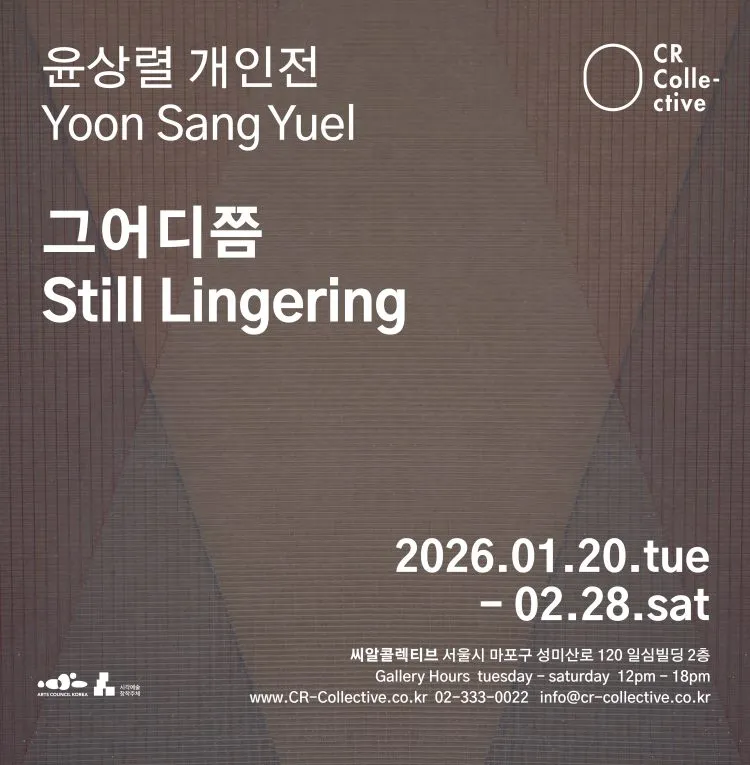
윤상렬의 작업은 시간의 축적 위에 반복과 질서, 선과 구조라는 조형 언어를 통해 평면을 드러내는 과정과 형식에 주목해 왔다. 그의 화면에서 반복은 극복이나 성취를 향한 수행의 과정이 아니라, 지속을 가능하게 하는 조건으로서 끝났어야 할 형식이 여전히 남아 있는 상태를 드러낸다. 2007년 첫 개인전 《두려움》 이후 이러한 수행적 언어와 신체성은 제거되거나 승화해야 할 대상이나 목표가 아닌, 수행과 완성이 유예된 이후에도 형식이 계속해서 작동하는 조건, 사라지지 않은 구조와 잔여이고, 끝내 그 어디쯤에 남아 있는 감정의 잔존을 응시한다. 여기서 ‘유예’는 완성을 미루는 시간적 태도를, ‘잔존’은 그 유예 이후에도 사라지지 않고 남아 형식을 지탱하는 상태를 가리킨다.
윤상렬에게 반복과 질서가 결론을 연기하는 구조적 태도에 가깝다면, 이를 실천하는 선은 언제나 정교하게 배열되고, 그 정교함은 닫힌 체계의 구조로 (보이지만) 단순하게 귀결되지 않는다. 이러한 불완전성 (완전성)은 의도된 결핍이 아니라, 형식이 스스로를 지속시키는 조건으로 ‘(완성되어 보이지만) 완성되지 않음에도 불구하고 작동을 멈추지 않는 상태’를 전시의 중심에 놓는다. 작가는 작가주의나 특정 스타일로 덧씌워진 이미지에 대한 공포와 두려움이 사라지지 않은 상태에서도 작업이 작동할 수 있는 형식과 잔여 시스템을 설계해야 했다. 이때 행위는 수행의 강도를 축적하기 위한 목적이 아니라, 수행이 더 이상 요구되지 않는 상태에 도달하기 위한 초기 설정으로 작동한다. 그는 신체와 손, 최적의 매체를 찾아 그것이 실패할 확률을 최소화하고, 반복되는 행위 속에서 감각이 어떻게 지속되는지를 조용히 기록해 왔다. 선을 긋고, 닦고, 깎으며, 쓸어내리는 반복적 행위는 감정의 정화나 치유를 지양하기보다는, 작업을 가능하게 하는 생의 리듬을 치밀하게 탐색한다.
이러한 태도는 오브제-평면, 입체 드로잉 같은 구조적 평면을 넘어 구조적 설치작업으로 확장된다. 종이 위 샤프펜 0.3~0.7mm의 흑연으로 노동집약적 선 긋기, 첨단디지털 프린팅을 통한 정밀한 선 새기기, 그리고 여러 겹의 층위를 드러내는 구조적 평면과 구조물로 확장된 형식들은 감성과 이성, 손과 시스템, 아날로그와 디지털이라는 이중의 구조를 형성한다. 이 과정에서 만들어진 겹과 층은 기억의 집적이자 시간의 두께로 작동하며, 화면은 단일한 의미를 향해 수렴하지 않고 미묘한 차이와 편차를 축적한다. 그의 선은 계산된 도형이 아니라 불안을 기록하는 신체의 궤적이며, 구조물은 기능적 완결체라기보다 감정의 균형을 임시로 지탱하는 장치에 가깝다. 그러나 이 구분은 이분법적 대립으로 수렴되기보다는 어떤 ‘중간 어디쯤의 상태’에 머물면서 지속적으로 형식만이 유지된다.
특히 그의 신작 <그어디쯤> 시리즈는 최첨단 정밀기술로 계산된 격자무늬 스크래치를 낸 도강판(LGP, Light Guide Plate) 위에 노동집약적 문지르기 방식으로 흔적 라인을 각도와 수치 개념을 더해 심화시키는 입체 드로잉으로, “‘그리지 않지만 쓸고 닦고 정리하는데 나타나고 사라진다’는 정의를 내린 이전 작업의 연결선상의 작업”(작가노트에서)이다. 또 다른 신작 <깊고넓고좁고높고>는 외형상 정글짐 같은 구조적 형태를 띠고 있으나, 단순한 조형적 구조물로 환원되기보다는 평면과 입체, 구조와 표면의 경계를 지속적으로 교란하는 상태로 제시된다. 윤상렬은 오랫동안 ‘구조적 평면이자 평면적 구조가 되는 상태’를 구상해 왔으며, <깊고넓고좁고높고>는 그 사유가 가장 집약적으로 드러나는 작업이다. 이 작업에서 구조는 더 이상 평면을 지지하기 위한 외부의 틀이 아니라, 그 자체로 하나의 평면적 조건으로 작동한다.
<깊고넓고좁고높고>의 제작 과정은 수행의 흔적을 드러내기보다는, 수행 이후에도 형식이 유지될 수 있는 조건을 탐색하는 데 집중한다. 작가는 다양한 전문가들과의 실험을 통해, 얇은 목재가 어떠한 환경 상태에서도 뒤틀림을 최소화할 수 있도록 ‘5mm라는 오차 범위’ 안에서 구조를 설계했다. 이음과 쌓음의 과정에서 통제와 균형은 서로를 억제하기보다 보완하며, 구조는 팽팽한 긴장을 유지한 채 서로를 지탱한다. 여기서 중요한 것은 노동의 강도나 기술적 성취가 아니라, 형식이 더 이상 지속적인 개입을 요구하지 않는 상태에 도달하는 것이다.
이 작업은 전시장 환경과의 관계 속에서 비로소 완결되지 않은 상태로 ‘유지’된다. 씨알콜렉티브 전시장 내 설치 장소의 빛의 변화, 바닥의 평평함, 층고와 벽, 그리고 관람자가 만들어내는 그림자의 깊이는 모두 작업상의 관계로 고려된다. 구조물은 빛을 반사하거나 차단하며, 시간에 따라 변화하는 그림자를 머금는다. 이러한 환경적 요소들은 작품을 완성으로 이끄는 외부 조건이 아니라, 완성이 계속해서 유예되는 상황을 지속시키는 장치로 작동한다. 이를 위해 유사 환경과 디지털 환경에서의 시뮬레이션이 병행되었으며, 작업은 특정한 순간의 완결된 형태가 아니라, 변화 속에서도 유지되는 상태를 지향한다. 이 지점에서 <깊고넓고좁고높고>는 윤상렬 작업 전반을 관통해 온 ‘수행 이후의 형식’이라는 문제를 가장 명확하게 드러낸다. 유지되는 구조물은 더 이상 손의 반복적 개입을 요구하지 않으며, 그럼에도 불구하고 붕괴되지 않는다. 수행은 제거된 것이 아니라, 형식의 내부로 위임된다. 구조는 작가의 행위를 대체하며, 통제와 균형은 스스로를 유지하는 조건으로 작동한다.
이번 전시 《그어디쯤 Still Lingering》은 이러한 태도가 명시적으로 드러나는 지점이다. ‘그 어딘가’라는 제목은 명확한 위치나 도착점을 지시하지 않는다. 그것은 주체와 탈주체 사이, 완벽과 실패 사이, 질서와 혼란 사이, 제도와 감정 사이에 놓인 중간 어디 쯤에 자리하며, 여전히 진행 중인 상태를 가리킨다. 두려움은 여전히 남아 있고, 시스템은 여전히 작동하지만, 그 안에서 작업은 중단되지 않는다. 오히려 이 전시는 도착하지 않음 자체를 하나의 윤리로 제안한다.
윤상렬의 화면은 표면적으로는 미니멀리즘 이후의 언어를 연상시킨다. 반복되는 선, 투명한 층, 균질해 보이는 구조는 탈주체적 질서와 통제의 시스템을 암시한다. 균질해 보이는 선들은 외관상 완벽한 시스템을 향해 나아가는 듯하지만, 손끝의 떨림과 호흡의 불균형은 그 질서를 끝내 완성하지 않는다. 이 불완전성은 기술적 미숙이나 의도적 파괴라기보다, 제도와 작가주의적 완벽성이란 명령 속에서 작가가 감각적으로 견뎌온 감정의 흔적에 가깝다. 또한 레이어의 축적 속에서 발생하는 편차와 오차는 질서를 붕괴시키기보다는, 그 질서가 종결되지 못한 채 완벽하게 유지되고 있음을 드러낸다. 그의 반복은 질서를 모방하면서 동시에 그 질서를 조금씩 마모시키며, 통제를 흉내 내되 그 내부에서 스스로를 붕괴시킨다. 이는 신체적 수행과 과정의 가시화를 비판적 전략으로 삼았던 포스트 미니멀리즘이 하나의 미학적 규범으로 제도화된 이후, 그 수행을 반복하거나 부정하는 대신 수행이 더 이상 요구되지 않는 형식의 상태를 설계하려는 시도로 읽힐 수 있다.
결국 이번 전시의 지향점은 ‘수행 없는 형식’이다. 윤상렬의 관심은 더 이상 의미화하는 행위의 강도나 신체의 드러남에 있지 않다. 반복은 여전히 존재하지만, 그것은 수행의 흔적이라기보다 조건 설정의 결과에 가깝다. 작가는 행위자가 아니라, 구조의 설계자로 위치를 이동한다. 손은 화면을 지배하지 않고, 시스템에 위임된다. 이때 작업은 신체적 수행을 통해 완성되지 않으며, 두려움과 제도적 압박을 견뎌온 증인의 자리에서 작동하며 오히려 수행이 불필요한 상태를 향해 나아간다. 이 전시는 불안을 극복한 이후의 서사가 아니라, 사적 감정이 형식의 조건으로 전환되는 지점에서 극복을 유예한 채 지속되는 하나의 윤리적 형식을 제안한다. 윤상렬은 동시대 회화가 이 지점에서 여전히 감각과 태도의 문제로 남아 있음을 환기시킨다.
오세원 (씨알콜렉티브 디렉터)
Yoon Sang Yuel has focused on the process and form of revealing the surface through the formative language of repetition and order, line and structure built upon the accumulation of time. In his works, repetition is not a process of performance toward overcoming or achievement, but rather reveals a state where form that should have ended still remains as both a condition enabling sustainability and a method of deliberate deferral. Since his first solo exhibition Fear (2007), this performative language and corporeality have not been objects or goals to be removed or sublimated, but rather conditions under which form continues to operate even after performance and completion have been deferred, structures and remnants that have not disappeared, ultimately gazing upon the residual emotions that remain somewhere in between. Here, “deferral” refers to a temporal attitude of postponing completion, while “residual” indicates a state that does not disappear even after that deferral and remains to support the form.
For Yoon, if repetition and order are closer to a structural attitude that postpones conclusions, the lines that enact this are always precisely arranged, and their precision does not simply result in the structure of a closed system (though it appears to). This incompleteness (completeness) is not intentional deficiency, but rather places at the center of the exhibition a condition for form to sustain itself: “a state that does not stop operating despite not being completed (though appearing to be completed).” Yoon had to design forms and residual systems that could operate even when the fear and anxiety about images overlaid with auteurism or specific styles had not disappeared. At this point, repetitive action operates not for the purpose of accumulating the intensity of performance, but as an initial condition-setting to reach a state where performance is no longer required. He has quietly and steadily recorded how sensation continues within repetitive actions by finding the body and hand, optimal media, minimizing the probability of their failure. Repetitive actions of drawing lines, wiping, scraping, and brushing down meticulously explore the rhythms of life that make work possible, rather than pursuing the purification or healing of emotions.
This attitude extends beyond object-surfaces and structural flat works like three-dimensional drawings to structural installation works. Labor-intensive line drawing with 0.3–0.7mm graphite mechanical pencils on paper, precise line engraving through advanced digital printing, and forms expanded into structural surfaces and constructions that reveal multiple layers create a dual structure of emotion and reason, hand and system, analog and digital. The layers and strata created in this process operate as both the accumulation of memory and the thickness of time, and the surface does not converge toward a single meaning but accumulates subtle differences and deviations. His lines are not calculated figures but bodily trajectories recording anxiety, and the structures are closer to devices temporarily supporting emotional balance rather than functional completions. However, rather than converging into binary opposition, this distinction remains in some “in-between state” where only form is continuously maintained.
Particularly, his new series of work Still Lingering is a three-dimensional drawing that deepens trace lines through labor-intensive rubbing methods on LGP (Light Guide Plate) with scratched grid patterns calculated with cutting-edge precision technology, adding concepts of angle and numerical value. According to the artist’s statement, this work is “in the lineage of previous pieces that defined [his practice as] ‘appearing and disappearing through sweeping, wiping, and organizing without drawing.’” Another new work Deep Wide Narrow High takes the structural form resembling a jungle gym on the surface, but rather than being reduced to a simple sculptural structure, it is presented as a state that continuously disrupts the boundaries between surface and three-dimension, structure and surface. Yoon has long conceived of “a state that becomes both structural surface and planar structure,” and Deep Wide Narrow High is the work where this thinking is most intensively revealed. In this work, structure no longer operates as an external frame to support the surface, but functions as a planar condition in itself.
The production process of Deep Wide Narrow High focuses on exploring conditions where form can be maintained even after performance, rather than revealing traces of performance. Through experiments with various specialists, Yoon designed the structure within “a 5mm margin of error” so that thin wood could minimize warping under any environmental conditions. In the process of joining and stacking, control and balance complement rather than suppress each other, and the structure supports itself while maintaining taut tension. What is important here is not the intensity of labor or technical achievement, but reaching a state where form no longer requires continuous intervention. This work is finally “maintained” in an incomplete state through its relationship with the exhibition environment. Changes in light at the installation location within the CR Collective exhibition space, the flatness of the floor, ceiling height and walls, and the depth of shadows created by visitors are all considered as working relationships. The structure reflects or blocks light and holds shadows that change over time. These environmental elements operate not as external conditions leading the work to completion, but as devices that sustain the situation where completion is continuously deferred. To this end, simulations in comparable physical settings and digital environments were conducted in parallel, and the work aims not for a completed form at a specific moment, but for a state maintained even under changing conditions. At this point, Deep Wide Narrow High most clearly reveals the problem of “form after performance” that has penetrated throughout Yoon’s work. The maintained structure no longer requires repetitive intervention by the hand, and yet does not collapse. Performance is not removed, but delegated to the interior of form. Structure replaces the artist’s action, and control and balance operate as conditions that maintain themselves.
This exhibition Still Lingering is the point where such an attitude is explicitly revealed. The literal meaning of the Korean title “그어디쯤” (somewhere in between) does not indicate a clear location or arrival point. It positions itself somewhere in between subject and non-subject, perfection and failure, order and chaos, institution and emotion, indicating a state still in progress. Fear still remains, systems still operate, but within that, this practice does not cease. Rather, this exhibition proposes non-arrival itself as an ethical stance.
Yoon’s works superficially evoke the language of post-minimalism. Repeating lines, transparent layers, and seemingly homogeneous structures suggest systems of non-subjective order and control. Lines that appear homogeneous seem to move toward an apparently perfect system, but trembling fingertips and breathing imbalances ultimately do not complete that order. This incompleteness is closer to traces of emotions the artist has sensually endured within commands of institutional and auteurist perfection, rather than technical immaturity or intentional destruction. Furthermore, deviations and errors occurring within repetition and layers do not collapse order, but reveal that the order is being perfectly maintained without reaching conclusion. His repetition mimics order while simultaneously, gradually eroding it, imitating control while collapsing itself from within. This can be read as an attempt to design a state of form where performance is no longer required—rather than repeating or negating that performance—under conditions in which post-minimalism, which once took the visualization of bodily performance and process as a critical strategy, has since been institutionalized as an aesthetic norm.
A particularly noteworthy point in this exhibition is the orientation toward “form without performance.” Yoon’s interest no longer lies in the intensity of meaning-making actions or the revelation of the body. Repetition still exists, but it is closer to the result of condition-setting rather than traces of performance. The artist shifts position from actor to designer of structure. The hand does not dominate the surface but is delegated to the system. At this point, the work is not completed through bodily performance, but operates from the position of a witness who has endured fear and institutional pressure, moving rather toward a state where performance is unnecessary. This exhibition proposes not a narrative after overcoming anxiety, but an ethical form that continues with overcoming deferred at the point where private emotions are converted into conditions of form. Yoon Sang Yuel reminds us that contemporary painting still remains a matter of sensation and attitude at this juncture.
Sewon Oh (Director of CR Collective)
윤상렬에게 반복과 질서가 결론을 연기하는 구조적 태도에 가깝다면, 이를 실천하는 선은 언제나 정교하게 배열되고, 그 정교함은 닫힌 체계의 구조로 (보이지만) 단순하게 귀결되지 않는다. 이러한 불완전성 (완전성)은 의도된 결핍이 아니라, 형식이 스스로를 지속시키는 조건으로 ‘(완성되어 보이지만) 완성되지 않음에도 불구하고 작동을 멈추지 않는 상태’를 전시의 중심에 놓는다. 작가는 작가주의나 특정 스타일로 덧씌워진 이미지에 대한 공포와 두려움이 사라지지 않은 상태에서도 작업이 작동할 수 있는 형식과 잔여 시스템을 설계해야 했다. 이때 행위는 수행의 강도를 축적하기 위한 목적이 아니라, 수행이 더 이상 요구되지 않는 상태에 도달하기 위한 초기 설정으로 작동한다. 그는 신체와 손, 최적의 매체를 찾아 그것이 실패할 확률을 최소화하고, 반복되는 행위 속에서 감각이 어떻게 지속되는지를 조용히 기록해 왔다. 선을 긋고, 닦고, 깎으며, 쓸어내리는 반복적 행위는 감정의 정화나 치유를 지양하기보다는, 작업을 가능하게 하는 생의 리듬을 치밀하게 탐색한다.
이러한 태도는 오브제-평면, 입체 드로잉 같은 구조적 평면을 넘어 구조적 설치작업으로 확장된다. 종이 위 샤프펜 0.3~0.7mm의 흑연으로 노동집약적 선 긋기, 첨단디지털 프린팅을 통한 정밀한 선 새기기, 그리고 여러 겹의 층위를 드러내는 구조적 평면과 구조물로 확장된 형식들은 감성과 이성, 손과 시스템, 아날로그와 디지털이라는 이중의 구조를 형성한다. 이 과정에서 만들어진 겹과 층은 기억의 집적이자 시간의 두께로 작동하며, 화면은 단일한 의미를 향해 수렴하지 않고 미묘한 차이와 편차를 축적한다. 그의 선은 계산된 도형이 아니라 불안을 기록하는 신체의 궤적이며, 구조물은 기능적 완결체라기보다 감정의 균형을 임시로 지탱하는 장치에 가깝다. 그러나 이 구분은 이분법적 대립으로 수렴되기보다는 어떤 ‘중간 어디쯤의 상태’에 머물면서 지속적으로 형식만이 유지된다.
특히 그의 신작 <그어디쯤> 시리즈는 최첨단 정밀기술로 계산된 격자무늬 스크래치를 낸 도강판(LGP, Light Guide Plate) 위에 노동집약적 문지르기 방식으로 흔적 라인을 각도와 수치 개념을 더해 심화시키는 입체 드로잉으로, “‘그리지 않지만 쓸고 닦고 정리하는데 나타나고 사라진다’는 정의를 내린 이전 작업의 연결선상의 작업”(작가노트에서)이다. 또 다른 신작 <깊고넓고좁고높고>는 외형상 정글짐 같은 구조적 형태를 띠고 있으나, 단순한 조형적 구조물로 환원되기보다는 평면과 입체, 구조와 표면의 경계를 지속적으로 교란하는 상태로 제시된다. 윤상렬은 오랫동안 ‘구조적 평면이자 평면적 구조가 되는 상태’를 구상해 왔으며, <깊고넓고좁고높고>는 그 사유가 가장 집약적으로 드러나는 작업이다. 이 작업에서 구조는 더 이상 평면을 지지하기 위한 외부의 틀이 아니라, 그 자체로 하나의 평면적 조건으로 작동한다.
<깊고넓고좁고높고>의 제작 과정은 수행의 흔적을 드러내기보다는, 수행 이후에도 형식이 유지될 수 있는 조건을 탐색하는 데 집중한다. 작가는 다양한 전문가들과의 실험을 통해, 얇은 목재가 어떠한 환경 상태에서도 뒤틀림을 최소화할 수 있도록 ‘5mm라는 오차 범위’ 안에서 구조를 설계했다. 이음과 쌓음의 과정에서 통제와 균형은 서로를 억제하기보다 보완하며, 구조는 팽팽한 긴장을 유지한 채 서로를 지탱한다. 여기서 중요한 것은 노동의 강도나 기술적 성취가 아니라, 형식이 더 이상 지속적인 개입을 요구하지 않는 상태에 도달하는 것이다.
이 작업은 전시장 환경과의 관계 속에서 비로소 완결되지 않은 상태로 ‘유지’된다. 씨알콜렉티브 전시장 내 설치 장소의 빛의 변화, 바닥의 평평함, 층고와 벽, 그리고 관람자가 만들어내는 그림자의 깊이는 모두 작업상의 관계로 고려된다. 구조물은 빛을 반사하거나 차단하며, 시간에 따라 변화하는 그림자를 머금는다. 이러한 환경적 요소들은 작품을 완성으로 이끄는 외부 조건이 아니라, 완성이 계속해서 유예되는 상황을 지속시키는 장치로 작동한다. 이를 위해 유사 환경과 디지털 환경에서의 시뮬레이션이 병행되었으며, 작업은 특정한 순간의 완결된 형태가 아니라, 변화 속에서도 유지되는 상태를 지향한다. 이 지점에서 <깊고넓고좁고높고>는 윤상렬 작업 전반을 관통해 온 ‘수행 이후의 형식’이라는 문제를 가장 명확하게 드러낸다. 유지되는 구조물은 더 이상 손의 반복적 개입을 요구하지 않으며, 그럼에도 불구하고 붕괴되지 않는다. 수행은 제거된 것이 아니라, 형식의 내부로 위임된다. 구조는 작가의 행위를 대체하며, 통제와 균형은 스스로를 유지하는 조건으로 작동한다.
이번 전시 《그어디쯤 Still Lingering》은 이러한 태도가 명시적으로 드러나는 지점이다. ‘그 어딘가’라는 제목은 명확한 위치나 도착점을 지시하지 않는다. 그것은 주체와 탈주체 사이, 완벽과 실패 사이, 질서와 혼란 사이, 제도와 감정 사이에 놓인 중간 어디 쯤에 자리하며, 여전히 진행 중인 상태를 가리킨다. 두려움은 여전히 남아 있고, 시스템은 여전히 작동하지만, 그 안에서 작업은 중단되지 않는다. 오히려 이 전시는 도착하지 않음 자체를 하나의 윤리로 제안한다.
윤상렬의 화면은 표면적으로는 미니멀리즘 이후의 언어를 연상시킨다. 반복되는 선, 투명한 층, 균질해 보이는 구조는 탈주체적 질서와 통제의 시스템을 암시한다. 균질해 보이는 선들은 외관상 완벽한 시스템을 향해 나아가는 듯하지만, 손끝의 떨림과 호흡의 불균형은 그 질서를 끝내 완성하지 않는다. 이 불완전성은 기술적 미숙이나 의도적 파괴라기보다, 제도와 작가주의적 완벽성이란 명령 속에서 작가가 감각적으로 견뎌온 감정의 흔적에 가깝다. 또한 레이어의 축적 속에서 발생하는 편차와 오차는 질서를 붕괴시키기보다는, 그 질서가 종결되지 못한 채 완벽하게 유지되고 있음을 드러낸다. 그의 반복은 질서를 모방하면서 동시에 그 질서를 조금씩 마모시키며, 통제를 흉내 내되 그 내부에서 스스로를 붕괴시킨다. 이는 신체적 수행과 과정의 가시화를 비판적 전략으로 삼았던 포스트 미니멀리즘이 하나의 미학적 규범으로 제도화된 이후, 그 수행을 반복하거나 부정하는 대신 수행이 더 이상 요구되지 않는 형식의 상태를 설계하려는 시도로 읽힐 수 있다.
결국 이번 전시의 지향점은 ‘수행 없는 형식’이다. 윤상렬의 관심은 더 이상 의미화하는 행위의 강도나 신체의 드러남에 있지 않다. 반복은 여전히 존재하지만, 그것은 수행의 흔적이라기보다 조건 설정의 결과에 가깝다. 작가는 행위자가 아니라, 구조의 설계자로 위치를 이동한다. 손은 화면을 지배하지 않고, 시스템에 위임된다. 이때 작업은 신체적 수행을 통해 완성되지 않으며, 두려움과 제도적 압박을 견뎌온 증인의 자리에서 작동하며 오히려 수행이 불필요한 상태를 향해 나아간다. 이 전시는 불안을 극복한 이후의 서사가 아니라, 사적 감정이 형식의 조건으로 전환되는 지점에서 극복을 유예한 채 지속되는 하나의 윤리적 형식을 제안한다. 윤상렬은 동시대 회화가 이 지점에서 여전히 감각과 태도의 문제로 남아 있음을 환기시킨다.
오세원 (씨알콜렉티브 디렉터)
Yoon Sang Yuel has focused on the process and form of revealing the surface through the formative language of repetition and order, line and structure built upon the accumulation of time. In his works, repetition is not a process of performance toward overcoming or achievement, but rather reveals a state where form that should have ended still remains as both a condition enabling sustainability and a method of deliberate deferral. Since his first solo exhibition Fear (2007), this performative language and corporeality have not been objects or goals to be removed or sublimated, but rather conditions under which form continues to operate even after performance and completion have been deferred, structures and remnants that have not disappeared, ultimately gazing upon the residual emotions that remain somewhere in between. Here, “deferral” refers to a temporal attitude of postponing completion, while “residual” indicates a state that does not disappear even after that deferral and remains to support the form.
For Yoon, if repetition and order are closer to a structural attitude that postpones conclusions, the lines that enact this are always precisely arranged, and their precision does not simply result in the structure of a closed system (though it appears to). This incompleteness (completeness) is not intentional deficiency, but rather places at the center of the exhibition a condition for form to sustain itself: “a state that does not stop operating despite not being completed (though appearing to be completed).” Yoon had to design forms and residual systems that could operate even when the fear and anxiety about images overlaid with auteurism or specific styles had not disappeared. At this point, repetitive action operates not for the purpose of accumulating the intensity of performance, but as an initial condition-setting to reach a state where performance is no longer required. He has quietly and steadily recorded how sensation continues within repetitive actions by finding the body and hand, optimal media, minimizing the probability of their failure. Repetitive actions of drawing lines, wiping, scraping, and brushing down meticulously explore the rhythms of life that make work possible, rather than pursuing the purification or healing of emotions.
This attitude extends beyond object-surfaces and structural flat works like three-dimensional drawings to structural installation works. Labor-intensive line drawing with 0.3–0.7mm graphite mechanical pencils on paper, precise line engraving through advanced digital printing, and forms expanded into structural surfaces and constructions that reveal multiple layers create a dual structure of emotion and reason, hand and system, analog and digital. The layers and strata created in this process operate as both the accumulation of memory and the thickness of time, and the surface does not converge toward a single meaning but accumulates subtle differences and deviations. His lines are not calculated figures but bodily trajectories recording anxiety, and the structures are closer to devices temporarily supporting emotional balance rather than functional completions. However, rather than converging into binary opposition, this distinction remains in some “in-between state” where only form is continuously maintained.
Particularly, his new series of work Still Lingering is a three-dimensional drawing that deepens trace lines through labor-intensive rubbing methods on LGP (Light Guide Plate) with scratched grid patterns calculated with cutting-edge precision technology, adding concepts of angle and numerical value. According to the artist’s statement, this work is “in the lineage of previous pieces that defined [his practice as] ‘appearing and disappearing through sweeping, wiping, and organizing without drawing.’” Another new work Deep Wide Narrow High takes the structural form resembling a jungle gym on the surface, but rather than being reduced to a simple sculptural structure, it is presented as a state that continuously disrupts the boundaries between surface and three-dimension, structure and surface. Yoon has long conceived of “a state that becomes both structural surface and planar structure,” and Deep Wide Narrow High is the work where this thinking is most intensively revealed. In this work, structure no longer operates as an external frame to support the surface, but functions as a planar condition in itself.
The production process of Deep Wide Narrow High focuses on exploring conditions where form can be maintained even after performance, rather than revealing traces of performance. Through experiments with various specialists, Yoon designed the structure within “a 5mm margin of error” so that thin wood could minimize warping under any environmental conditions. In the process of joining and stacking, control and balance complement rather than suppress each other, and the structure supports itself while maintaining taut tension. What is important here is not the intensity of labor or technical achievement, but reaching a state where form no longer requires continuous intervention. This work is finally “maintained” in an incomplete state through its relationship with the exhibition environment. Changes in light at the installation location within the CR Collective exhibition space, the flatness of the floor, ceiling height and walls, and the depth of shadows created by visitors are all considered as working relationships. The structure reflects or blocks light and holds shadows that change over time. These environmental elements operate not as external conditions leading the work to completion, but as devices that sustain the situation where completion is continuously deferred. To this end, simulations in comparable physical settings and digital environments were conducted in parallel, and the work aims not for a completed form at a specific moment, but for a state maintained even under changing conditions. At this point, Deep Wide Narrow High most clearly reveals the problem of “form after performance” that has penetrated throughout Yoon’s work. The maintained structure no longer requires repetitive intervention by the hand, and yet does not collapse. Performance is not removed, but delegated to the interior of form. Structure replaces the artist’s action, and control and balance operate as conditions that maintain themselves.
This exhibition Still Lingering is the point where such an attitude is explicitly revealed. The literal meaning of the Korean title “그어디쯤” (somewhere in between) does not indicate a clear location or arrival point. It positions itself somewhere in between subject and non-subject, perfection and failure, order and chaos, institution and emotion, indicating a state still in progress. Fear still remains, systems still operate, but within that, this practice does not cease. Rather, this exhibition proposes non-arrival itself as an ethical stance.
Yoon’s works superficially evoke the language of post-minimalism. Repeating lines, transparent layers, and seemingly homogeneous structures suggest systems of non-subjective order and control. Lines that appear homogeneous seem to move toward an apparently perfect system, but trembling fingertips and breathing imbalances ultimately do not complete that order. This incompleteness is closer to traces of emotions the artist has sensually endured within commands of institutional and auteurist perfection, rather than technical immaturity or intentional destruction. Furthermore, deviations and errors occurring within repetition and layers do not collapse order, but reveal that the order is being perfectly maintained without reaching conclusion. His repetition mimics order while simultaneously, gradually eroding it, imitating control while collapsing itself from within. This can be read as an attempt to design a state of form where performance is no longer required—rather than repeating or negating that performance—under conditions in which post-minimalism, which once took the visualization of bodily performance and process as a critical strategy, has since been institutionalized as an aesthetic norm.
A particularly noteworthy point in this exhibition is the orientation toward “form without performance.” Yoon’s interest no longer lies in the intensity of meaning-making actions or the revelation of the body. Repetition still exists, but it is closer to the result of condition-setting rather than traces of performance. The artist shifts position from actor to designer of structure. The hand does not dominate the surface but is delegated to the system. At this point, the work is not completed through bodily performance, but operates from the position of a witness who has endured fear and institutional pressure, moving rather toward a state where performance is unnecessary. This exhibition proposes not a narrative after overcoming anxiety, but an ethical form that continues with overcoming deferred at the point where private emotions are converted into conditions of form. Yoon Sang Yuel reminds us that contemporary painting still remains a matter of sensation and attitude at this juncture.
Sewon Oh (Director of CR Collective)
| 작가 | 윤상렬 Yoon Sang Yuel |
| 전시장 | 씨알콜렉티브 (CR Collective, シーアール・コレクティブ) |
| 주소 | 03988 서울특별시 마포구 성미산로 120 일심빌딩 2층주소 복사하기복사 |
| 오시는 길 | 서울 지하철 2호선 홍대입구역 2번 출구에서 도보 15분. 혹은 06번 마을버스를 타고 정류장 – '경성중고, 홍익디자인고등학교앞' 에서 하차. |
| 기간 | 2026.01.20(화) - 02.28(토) |
| 관람시간 | 12:00 - 18:00 |
| 휴일 | 일요일, 월요일, 공휴일 |
| SNS |  |
| 웹사이트 |