


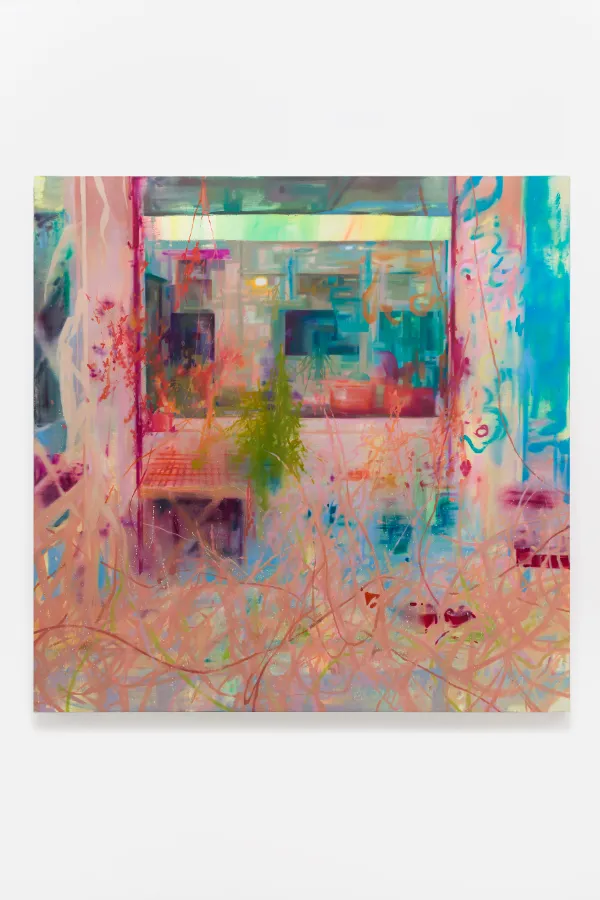
 구유빈, Autumn Breeze, oil on canvas, 150 x 150 cm, 2025(제공: 인가희갤러리)
기억은 어떻게 이어지고 변형되는가: 《레가토 Legato》
- 구유빈 첫 개인전, 장면의 재현이 아닌 기억의 리듬을 그려내는 회화적 실험
- 유화의 층과 흔적, 지워짐과 덧씌움으로 드러나는 ‘구성되는 기억’의 풍경
- 식물의 잔상과 반복되는 화면의 흐름 속에서, 보는 일과 기억하는 일 사이를 묻다
인가희갤러리(INGAHEE)는 오는 4월, 구유빈의 첫 개인전 《레가토 Legato》를 개최한다. 이번 전시는 하나의 장면을 선명하게 제시하는 대신, 여러 감각과 인상이 겹쳐지고 스며드는 과정 자체를 회화로 풀어낸다. 구유빈은 이미지를 고정된 대상으로 다루기보다, 시간이 지나며 흐려지고 변형되며 다시 떠오르는 감각의 상태로 다룬다. 관람자는 각각의 작품을 독립된 이미지로 보기보다, 화면과 화면 사이를 오가며 이어지는 잔상과 리듬 속에서 전시를 경험하게 된다.
구유빈의 회화는 유화라는 매체의 물질적 특성을 적극적으로 드러내며 형성된다. 작가는 화면 위에 이미지를 쌓아 올리고, 다시 덮고, 긁어내고, 수정하는 과정을 반복한다. 이러한 축적의 방식은 단순한 제작 과정에 머무르지 않고, 하나의 화면 안에 시간의 흐름과 감각의 흔적을 함께 남긴다. 두껍게 밀어 올린 마티에르, 아래층을 드러내는 긁힌 자국, 지워지지 않고 남아 있는 수정의 흔적은 회화를 하나의 결과물이라기보다 변화가 계속 기록되는 장으로 보게 만든다.
전시 제목인 ‘레가토(Legato)’는 음과 음이 끊어지지 않고 이어지는 음악 용어에서 가져왔다. 이 개념은 이번 전시에서 작품과 작품 사이의 관계를 이해하는 중요한 단서가 된다. 각 화면은 하나의 완결된 이미지라기보다, 앞선 인상과 다음 장면을 부드럽게 연결하는 흐름의 일부로 기능한다. 비슷한 색조, 번져 나가는 형태, 반복적으로 등장하는 식물의 형상은 전시 전체를 하나의 시각적 리듬으로 묶어내며, 관람의 경험을 장면의 해석보다 감각의 이동에 가깝게 만든다.
특히 화면 속 식물은 이번 전시를 관통하는 주요한 모티프다. 식물의 잎맥과 줄기, 퍼져 나가는 방향성은 각각 다른 작품 안에서 조금씩 다른 형상으로 되풀이되며, 전시 공간 안에 느슨하지만 분명한 연결을 만든다. 그것은 특정한 상징으로 고정되기보다, 이미지와 이미지 사이를 이어주는 시각적 호흡처럼 작동한다. 이를 통해 관람자는 하나의 장면을 읽기보다, 전시 전체를 통과하며 반복과 변주의 감각을 따라가게 된다.
《레가토 Legato》는 기억이나 장면을 명확하게 복원하는 회화를 다루기 보다, 오히려 남아 있는 인상, 사라지는 윤곽, 뒤늦게 떠오르는 감각처럼 언어로 쉽게 고정되지 않는 상태를 제안한다. 이번 전시는 회화를 통해 보는 일이 단순한 인식이 아니라, 감각이 축적되고 흔들리며 다시 이어지는 과정임을 보여주며, 관람자에게 자신이 무엇을 보았는지보다 어떻게 보고 지나왔는지를 되돌아보게 할 것이다.
In April, INGAHEE will present Legato, the first solo exhibition by Koo Yubin. Rather than offering a single clearly defined scene, the exhibition unfolds through overlapping, permeating, and lingering sensations. Koo approaches images not as fixed subjects, but as mutable states of feeling—ones that fade, transform, and re-emerge over time. Viewers are invited to experience the exhibition not as a series of individual works, but by moving between canvases and sensing the afterimages and rhythms that carry from one work to the next.
Koo’s paintings are formed through an active engagement with the material properties of oil paint. The artist repeatedly layers images onto the surface, covers them over, scratches them away, and revises them. This accumulative process is not simply a method of production; it allows each canvas to retain traces of duration and sensation within a single surface. Thick impasto, scraped marks that reveal lower layers, and revisions that remain visible all lead the viewer to understand painting not merely as a finished result, but as a site where change continues to be recorded.
The exhibition title, Legato, is borrowed from the musical term for notes played smoothly and continuously without interruption. Here, the concept offers an important key to understanding the relationship between the works. Each painting functions less as a complete and closed image than as part of a larger flow, gently linking a previous impression to the next scene. Similar tonal atmospheres, diffused forms, and recurring vegetal motifs bind the exhibition into a single visual rhythm, shifting the experience of viewing away from interpretation of individual scenes and toward the movement of sensation itself.
The vegetal imagery that appears throughout the exhibition serves as one of its central motifs. Leaf veins, stems, and spreading directional forms recur across different works in slightly altered ways, creating a loose yet perceptible continuity throughout the space. Rather than being fixed as symbols, these forms operate more like a visual breath that connects one image to another. Through them, viewers are encouraged not simply to read each scene, but to follow the exhibition as a whole through patterns of repetition and variation.
Legato does not present a body of paintings that seeks to restore memory or reconstruct scenes with clarity. Rather, it proposes perceptual states that resist linguistic fixation—lingering impressions, dissolving contours, and sensations that surface belatedly—suspended within the materiality of oil paint. In doing so, the exhibition suggests that seeing is not a straightforward act of recognition, but a process through which sensation accumulates, wavers, and continues. Ultimately, Legato invites viewers to reflect less on what exactly they saw than on how they moved through the act of seeing itself.
■ 전시 서문
“보이는 것(시각)의 피할 수 없는 양태—나는 눈을 통해 생각한다.”
—제임스 조이스, 『율리시스』, 에피소드 3 「프로테우스」
우리는 기억을 남기기 위해 이미지를 저장한다. 화면 속에서 경험은 폴더가 되고, 정리는 습관이 되며, “기록”은 종종 경험의 동의어가 된다. 그러나 이 간편한 등식에는 역설이 숨어 있다. 사진을 찍는 행위가 관찰을 대신할 때, 그 순간의 세부가 오히려 덜 남을 수도 있다는 연구들이 보고되어 왔다. 물론 그 결과는 언제나 동일하지 않다. 무엇을, 어떻게, 얼마나 집중해서 촬영했는지에 따라 달라질 수 있다. 그럼에도 중요한 통찰은 분명하다. 카메라가 ‘기억의 외주화’를 맡는 동안, 우리의 주의와 감각은 다른 방식으로 배분되고, 그 배분은 이후의 회상에 흔적을 남긴다. 구유빈의 작업은 이 지점에서 출발한다. 작가가 붙잡는 것은 ‘정확한 장면’이 아니라, 장면이 기억으로 바뀌는 과정의 불안정성—어떤 부분은 사라지고, 어떤 부분은 강조되며, 어떤 색은 사후적으로 덧씌워지는 그 변형의 순간이다.
기억 연구는 오래전부터 기억을 ‘복제’가 아닌 ‘구성’의 과정으로 설명해 왔다. 우리는 과거를 그대로 꺼내는 것이 아니라, 현재의 정서·목적·맥락에 맞추어 파편을 다시 조립한다. 그래서 기억은 늘 부분적이고, 때로는 왜곡되며, 그 왜곡은 단순한 결함이 아니라 인간 인지가 작동하는 방식의 표지이기도 하다. 구유빈의 《레가토》는 이 구성적 기억을 음악적 개념으로 번역한다. ‘레가토’는 음과 음을 끊지 않고 이어 연주하는 방식이다. 각 음은 독립적이되, 앞선 음의 여운을 품은 채 다음 음으로 넘어간다. 이 전시에서 ‘여운’은 시각의 잔상이며, ‘이어짐’은 연상의 이동이다. 화면들은 단절된 사건의 연쇄가 아니라, 서로 스며들어 리듬을 이루는 인지의 흐름으로 작동한다.
이 흐름을 가능하게 하는 것은 무엇보다 유화의 물질성이다. 이 회화에서 유화는 매체라기보다 사건이다. 작가는 이미지를 겹치고, 구상과 추상이 서로를 덮고, 다시 긁어내며, 다시 쌓아 올리고, 다시 그려낸다. 그 반복은 완성을 향한 직선이 아니라, 기억의 운동—삭제와 덧붙임, 선명함과 흐림, 소멸과 재등장—을 표면 위에서 재연하는 리듬이다. 임파스토의 두꺼운 마티에르는 감각의 압력을 물질로 밀어 올려, “그때”의 감정을 하나의 질감으로 굳힌다. 그라타주의 긁어냄은 아래층을 노출시키며, 회상이 언제나 ‘뒤늦게 도착하는 이전의 층위’를 동반한다는 사실을 드러낸다. 그리고 펜티멘토—수정의 흔적이 시간이 지나 되비치거나 감지되는 현상—는 이 회화에서 우연한 부스러기가 아니라, 기억의 윤리로서 기능한다. 바꾼 흔적을 숨기지 않고 남겨 두는 것. 잊힘과 변경을 결함이 아니라 구조로 받아들이는 것. 그리하여 한 화면은 ‘지금의 이미지’이면서 동시에 ‘이전에 있었던 이미지의 유령’을 품게 된다.
<레가토> 전시에서 반복적으로 등장하는 식물은 그러한 층위를 관통하는 시각적 단서다. 식물은 고정된 객체라기보다, 번지고 자라며 퍼지는 존재다. 그래서 그것은 장면을 상징으로 봉인하기보다 장면을 통과하는 리듬으로 남는다. 같은 잎맥이 다른 빛에서 다시 나타나고, 비슷한 뻗음이 다른 공간에 이식되며, 관람자는 ‘무엇을 보았는지’보다 ‘어떻게 이어서 보게 되는지’를 체감한다. 식물은 여기서 레가토의 도치된 박자표처럼 작동한다. 끝을 찍는 대상이 아니라, 다음 장면으로 밀어 넣는 여운이다.
관람을 위한 하나의 제안을 덧붙인다. 이 전시는 ‘읽히는’ 전시라기보다, 시각적 리듬으로 ‘감각되는’ 전시에 가깝다. 처음에는 한 작품 앞에서 오래 머물기보다, 몇 걸음 간격으로 이동하며 잔상을 의식해 보기를 권한다. 이어서 다시 돌아와, 방금 본 화면이 현재의 화면에 어떻게 들러붙는지—색의 공기, 지워진 윤곽, 반복되는 식물의 리듬—를 확인해 보라. 가능하다면 촬영을 잠시 미루고, 기억이 스스로 편집되는 속도를 허용해 보라. 이 전시의 핵심은 ‘어떤 장면’이 아니라, 장면과 장면 사이에서 당신의 인지가 어떻게 변주되는가에 있다.
구유빈의 ‘레가토 Legato’는 기억을 과거에 고정하지 않는다. 오히려 기억이 현재의 감정과 시선에 의해 계속 새로 만들어진다는 사실을, 유화의 층과 흔적, 공백과 잔상으로 설득한다. 그 설득은 결론을 강요하지 않는다. 대신 우리에게 질문을 남긴다. 우리가 “보았다”고 믿는 것은 과연 무엇이었는가. 그리고 우리가 “기억한다”고 말할 때, 그 기억은 얼마나 현재형인가.
(글. 인가희)
Koo Yubin: Legato
“Ineluctable modality of the visible: at least that if no more, thought through my eyes.”
—James Joyce, Ulysses, Episode 3, “Proteus”
We store images to preserve memory. On screens, experience becomes folders, organization becomes habitual, and “record” often becomes synonymous with experience itself. Yet a paradox lies hidden within this convenient equation. Studies have suggested that when the act of taking a photograph replaces observation, fewer details of the moment may actually remain. Of course, the outcome is not always the same. It may vary depending on what is photographed, how it is photographed, and the degree of attention given to the act. Even so, one important insight remains clear: while the camera takes on the role of “outsourcing memory,” our attention and sensory perception are distributed differently, and that distribution leaves traces in later recollection. It is precisely here that Koo Yubin’s work begins. What the artist seeks to hold onto is not the “accurate scene,” but the instability of the process by which a scene becomes memory—that transformative moment in which certain parts disappear, others are emphasized, and certain colors are overlaid retrospectively.
Memory studies have long described memory not as a process of “reproduction,” but of “construction.” We do not retrieve the past exactly as it was; rather, we reassemble fragments according to the emotions, purposes, and contexts of the present. For this reason, memory is always partial and at times distorted, yet such distortion is not merely a flaw, but an index of how human cognition operates. Koo’s Legato translates this constructive nature of memory into musical terms. Legato refers to a mode of performance in which notes are played without interruption, connected seamlessly to one another. Each note remains distinct, yet passes into the next while carrying the resonance of the one before it. In this exhibition, that “resonance” becomes the afterimage of vision, and that “continuity” becomes the movement of association. The paintings function not as a succession of discrete events, but as a cognitive flow in which images permeate one another and form a rhythm.
What makes this flow possible, above all, is the materiality of oil paint. In these works, oil painting is less a medium than an event. The artist layers images, allows figuration and abstraction to cover one another, scrapes them away, builds them up again, and paints over them once more. This repetition does not form a straight line toward completion; rather, it reenacts on the surface the movement of memory itself—erasure and addition, clarity and blur, disappearance and reemergence. The thick materiality of impasto pushes the pressure of sensation into matter, solidifying the emotion of “that time” into a texture. The scraping of grattage exposes the lower strata, revealing that recollection is always accompanied by “an earlier layer that emerges belatedly.” And pentimento—the phenomenon in which traces of revision become visible or perceptible over time—functions here not as an accidental residue, but as an ethics of memory. It means leaving altered traces visible rather than concealing them; accepting forgetting and change not as flaws, but as structure. In this way, each canvas becomes at once the “image of the present” and a surface haunted by “the ghost of an image that once existed.”
The plants that recur throughout Legato serve as visual cues cutting across these layers. Plants are not fixed objects, but beings that spread, grow, and proliferate. For that reason, they do not seal a scene into symbol, but remain as rhythms moving through it. The same leaf veins reappear under different light; similar extensions are transplanted into different spaces; and the viewer comes to sense less “what was seen” than “how one is led to continue seeing.” Here, the plant functions like an inverted time signature of legato: not a motif that marks an end, but an aftertone that propels one into the next scene.
A brief suggestion for viewing: Legato is less to be “read” than to be sensed through visual rhythm. At first, rather than lingering too long in front of a single work, I suggest moving at intervals of a few steps while remaining aware of afterimages. Then return and observe how the image you have just seen adheres to the one before you now—the atmosphere of color, the erased contours, the recurring vegetal rhythm. If possible, postpone taking photographs for a moment, and allow memory to edit itself at its own pace. The core of this exhibition lies not in “a particular scene,” but in how your cognition is modulated in the intervals between one scene and another.
Koo’s Legato does not fix memory in the past. Rather, through the layers and traces of oil paint, through blanks and afterimages, it persuades us that memory is continually remade by present emotion and perception. Yet this persuasion does not impose a conclusion. Instead, it leaves us with a question: what is it, exactly, that we believe we have seen? And when we say we “remember,” how much of that memory belongs to the present tense?
Text by Gahee In
- 구유빈 첫 개인전, 장면의 재현이 아닌 기억의 리듬을 그려내는 회화적 실험
- 유화의 층과 흔적, 지워짐과 덧씌움으로 드러나는 ‘구성되는 기억’의 풍경
- 식물의 잔상과 반복되는 화면의 흐름 속에서, 보는 일과 기억하는 일 사이를 묻다
인가희갤러리(INGAHEE)는 오는 4월, 구유빈의 첫 개인전 《레가토 Legato》를 개최한다. 이번 전시는 하나의 장면을 선명하게 제시하는 대신, 여러 감각과 인상이 겹쳐지고 스며드는 과정 자체를 회화로 풀어낸다. 구유빈은 이미지를 고정된 대상으로 다루기보다, 시간이 지나며 흐려지고 변형되며 다시 떠오르는 감각의 상태로 다룬다. 관람자는 각각의 작품을 독립된 이미지로 보기보다, 화면과 화면 사이를 오가며 이어지는 잔상과 리듬 속에서 전시를 경험하게 된다.
구유빈의 회화는 유화라는 매체의 물질적 특성을 적극적으로 드러내며 형성된다. 작가는 화면 위에 이미지를 쌓아 올리고, 다시 덮고, 긁어내고, 수정하는 과정을 반복한다. 이러한 축적의 방식은 단순한 제작 과정에 머무르지 않고, 하나의 화면 안에 시간의 흐름과 감각의 흔적을 함께 남긴다. 두껍게 밀어 올린 마티에르, 아래층을 드러내는 긁힌 자국, 지워지지 않고 남아 있는 수정의 흔적은 회화를 하나의 결과물이라기보다 변화가 계속 기록되는 장으로 보게 만든다.
전시 제목인 ‘레가토(Legato)’는 음과 음이 끊어지지 않고 이어지는 음악 용어에서 가져왔다. 이 개념은 이번 전시에서 작품과 작품 사이의 관계를 이해하는 중요한 단서가 된다. 각 화면은 하나의 완결된 이미지라기보다, 앞선 인상과 다음 장면을 부드럽게 연결하는 흐름의 일부로 기능한다. 비슷한 색조, 번져 나가는 형태, 반복적으로 등장하는 식물의 형상은 전시 전체를 하나의 시각적 리듬으로 묶어내며, 관람의 경험을 장면의 해석보다 감각의 이동에 가깝게 만든다.
특히 화면 속 식물은 이번 전시를 관통하는 주요한 모티프다. 식물의 잎맥과 줄기, 퍼져 나가는 방향성은 각각 다른 작품 안에서 조금씩 다른 형상으로 되풀이되며, 전시 공간 안에 느슨하지만 분명한 연결을 만든다. 그것은 특정한 상징으로 고정되기보다, 이미지와 이미지 사이를 이어주는 시각적 호흡처럼 작동한다. 이를 통해 관람자는 하나의 장면을 읽기보다, 전시 전체를 통과하며 반복과 변주의 감각을 따라가게 된다.
《레가토 Legato》는 기억이나 장면을 명확하게 복원하는 회화를 다루기 보다, 오히려 남아 있는 인상, 사라지는 윤곽, 뒤늦게 떠오르는 감각처럼 언어로 쉽게 고정되지 않는 상태를 제안한다. 이번 전시는 회화를 통해 보는 일이 단순한 인식이 아니라, 감각이 축적되고 흔들리며 다시 이어지는 과정임을 보여주며, 관람자에게 자신이 무엇을 보았는지보다 어떻게 보고 지나왔는지를 되돌아보게 할 것이다.
In April, INGAHEE will present Legato, the first solo exhibition by Koo Yubin. Rather than offering a single clearly defined scene, the exhibition unfolds through overlapping, permeating, and lingering sensations. Koo approaches images not as fixed subjects, but as mutable states of feeling—ones that fade, transform, and re-emerge over time. Viewers are invited to experience the exhibition not as a series of individual works, but by moving between canvases and sensing the afterimages and rhythms that carry from one work to the next.
Koo’s paintings are formed through an active engagement with the material properties of oil paint. The artist repeatedly layers images onto the surface, covers them over, scratches them away, and revises them. This accumulative process is not simply a method of production; it allows each canvas to retain traces of duration and sensation within a single surface. Thick impasto, scraped marks that reveal lower layers, and revisions that remain visible all lead the viewer to understand painting not merely as a finished result, but as a site where change continues to be recorded.
The exhibition title, Legato, is borrowed from the musical term for notes played smoothly and continuously without interruption. Here, the concept offers an important key to understanding the relationship between the works. Each painting functions less as a complete and closed image than as part of a larger flow, gently linking a previous impression to the next scene. Similar tonal atmospheres, diffused forms, and recurring vegetal motifs bind the exhibition into a single visual rhythm, shifting the experience of viewing away from interpretation of individual scenes and toward the movement of sensation itself.
The vegetal imagery that appears throughout the exhibition serves as one of its central motifs. Leaf veins, stems, and spreading directional forms recur across different works in slightly altered ways, creating a loose yet perceptible continuity throughout the space. Rather than being fixed as symbols, these forms operate more like a visual breath that connects one image to another. Through them, viewers are encouraged not simply to read each scene, but to follow the exhibition as a whole through patterns of repetition and variation.
Legato does not present a body of paintings that seeks to restore memory or reconstruct scenes with clarity. Rather, it proposes perceptual states that resist linguistic fixation—lingering impressions, dissolving contours, and sensations that surface belatedly—suspended within the materiality of oil paint. In doing so, the exhibition suggests that seeing is not a straightforward act of recognition, but a process through which sensation accumulates, wavers, and continues. Ultimately, Legato invites viewers to reflect less on what exactly they saw than on how they moved through the act of seeing itself.
■ 전시 서문
“보이는 것(시각)의 피할 수 없는 양태—나는 눈을 통해 생각한다.”
—제임스 조이스, 『율리시스』, 에피소드 3 「프로테우스」
우리는 기억을 남기기 위해 이미지를 저장한다. 화면 속에서 경험은 폴더가 되고, 정리는 습관이 되며, “기록”은 종종 경험의 동의어가 된다. 그러나 이 간편한 등식에는 역설이 숨어 있다. 사진을 찍는 행위가 관찰을 대신할 때, 그 순간의 세부가 오히려 덜 남을 수도 있다는 연구들이 보고되어 왔다. 물론 그 결과는 언제나 동일하지 않다. 무엇을, 어떻게, 얼마나 집중해서 촬영했는지에 따라 달라질 수 있다. 그럼에도 중요한 통찰은 분명하다. 카메라가 ‘기억의 외주화’를 맡는 동안, 우리의 주의와 감각은 다른 방식으로 배분되고, 그 배분은 이후의 회상에 흔적을 남긴다. 구유빈의 작업은 이 지점에서 출발한다. 작가가 붙잡는 것은 ‘정확한 장면’이 아니라, 장면이 기억으로 바뀌는 과정의 불안정성—어떤 부분은 사라지고, 어떤 부분은 강조되며, 어떤 색은 사후적으로 덧씌워지는 그 변형의 순간이다.
기억 연구는 오래전부터 기억을 ‘복제’가 아닌 ‘구성’의 과정으로 설명해 왔다. 우리는 과거를 그대로 꺼내는 것이 아니라, 현재의 정서·목적·맥락에 맞추어 파편을 다시 조립한다. 그래서 기억은 늘 부분적이고, 때로는 왜곡되며, 그 왜곡은 단순한 결함이 아니라 인간 인지가 작동하는 방식의 표지이기도 하다. 구유빈의 《레가토》는 이 구성적 기억을 음악적 개념으로 번역한다. ‘레가토’는 음과 음을 끊지 않고 이어 연주하는 방식이다. 각 음은 독립적이되, 앞선 음의 여운을 품은 채 다음 음으로 넘어간다. 이 전시에서 ‘여운’은 시각의 잔상이며, ‘이어짐’은 연상의 이동이다. 화면들은 단절된 사건의 연쇄가 아니라, 서로 스며들어 리듬을 이루는 인지의 흐름으로 작동한다.
이 흐름을 가능하게 하는 것은 무엇보다 유화의 물질성이다. 이 회화에서 유화는 매체라기보다 사건이다. 작가는 이미지를 겹치고, 구상과 추상이 서로를 덮고, 다시 긁어내며, 다시 쌓아 올리고, 다시 그려낸다. 그 반복은 완성을 향한 직선이 아니라, 기억의 운동—삭제와 덧붙임, 선명함과 흐림, 소멸과 재등장—을 표면 위에서 재연하는 리듬이다. 임파스토의 두꺼운 마티에르는 감각의 압력을 물질로 밀어 올려, “그때”의 감정을 하나의 질감으로 굳힌다. 그라타주의 긁어냄은 아래층을 노출시키며, 회상이 언제나 ‘뒤늦게 도착하는 이전의 층위’를 동반한다는 사실을 드러낸다. 그리고 펜티멘토—수정의 흔적이 시간이 지나 되비치거나 감지되는 현상—는 이 회화에서 우연한 부스러기가 아니라, 기억의 윤리로서 기능한다. 바꾼 흔적을 숨기지 않고 남겨 두는 것. 잊힘과 변경을 결함이 아니라 구조로 받아들이는 것. 그리하여 한 화면은 ‘지금의 이미지’이면서 동시에 ‘이전에 있었던 이미지의 유령’을 품게 된다.
<레가토> 전시에서 반복적으로 등장하는 식물은 그러한 층위를 관통하는 시각적 단서다. 식물은 고정된 객체라기보다, 번지고 자라며 퍼지는 존재다. 그래서 그것은 장면을 상징으로 봉인하기보다 장면을 통과하는 리듬으로 남는다. 같은 잎맥이 다른 빛에서 다시 나타나고, 비슷한 뻗음이 다른 공간에 이식되며, 관람자는 ‘무엇을 보았는지’보다 ‘어떻게 이어서 보게 되는지’를 체감한다. 식물은 여기서 레가토의 도치된 박자표처럼 작동한다. 끝을 찍는 대상이 아니라, 다음 장면으로 밀어 넣는 여운이다.
관람을 위한 하나의 제안을 덧붙인다. 이 전시는 ‘읽히는’ 전시라기보다, 시각적 리듬으로 ‘감각되는’ 전시에 가깝다. 처음에는 한 작품 앞에서 오래 머물기보다, 몇 걸음 간격으로 이동하며 잔상을 의식해 보기를 권한다. 이어서 다시 돌아와, 방금 본 화면이 현재의 화면에 어떻게 들러붙는지—색의 공기, 지워진 윤곽, 반복되는 식물의 리듬—를 확인해 보라. 가능하다면 촬영을 잠시 미루고, 기억이 스스로 편집되는 속도를 허용해 보라. 이 전시의 핵심은 ‘어떤 장면’이 아니라, 장면과 장면 사이에서 당신의 인지가 어떻게 변주되는가에 있다.
구유빈의 ‘레가토 Legato’는 기억을 과거에 고정하지 않는다. 오히려 기억이 현재의 감정과 시선에 의해 계속 새로 만들어진다는 사실을, 유화의 층과 흔적, 공백과 잔상으로 설득한다. 그 설득은 결론을 강요하지 않는다. 대신 우리에게 질문을 남긴다. 우리가 “보았다”고 믿는 것은 과연 무엇이었는가. 그리고 우리가 “기억한다”고 말할 때, 그 기억은 얼마나 현재형인가.
(글. 인가희)
Koo Yubin: Legato
“Ineluctable modality of the visible: at least that if no more, thought through my eyes.”
—James Joyce, Ulysses, Episode 3, “Proteus”
We store images to preserve memory. On screens, experience becomes folders, organization becomes habitual, and “record” often becomes synonymous with experience itself. Yet a paradox lies hidden within this convenient equation. Studies have suggested that when the act of taking a photograph replaces observation, fewer details of the moment may actually remain. Of course, the outcome is not always the same. It may vary depending on what is photographed, how it is photographed, and the degree of attention given to the act. Even so, one important insight remains clear: while the camera takes on the role of “outsourcing memory,” our attention and sensory perception are distributed differently, and that distribution leaves traces in later recollection. It is precisely here that Koo Yubin’s work begins. What the artist seeks to hold onto is not the “accurate scene,” but the instability of the process by which a scene becomes memory—that transformative moment in which certain parts disappear, others are emphasized, and certain colors are overlaid retrospectively.
Memory studies have long described memory not as a process of “reproduction,” but of “construction.” We do not retrieve the past exactly as it was; rather, we reassemble fragments according to the emotions, purposes, and contexts of the present. For this reason, memory is always partial and at times distorted, yet such distortion is not merely a flaw, but an index of how human cognition operates. Koo’s Legato translates this constructive nature of memory into musical terms. Legato refers to a mode of performance in which notes are played without interruption, connected seamlessly to one another. Each note remains distinct, yet passes into the next while carrying the resonance of the one before it. In this exhibition, that “resonance” becomes the afterimage of vision, and that “continuity” becomes the movement of association. The paintings function not as a succession of discrete events, but as a cognitive flow in which images permeate one another and form a rhythm.
What makes this flow possible, above all, is the materiality of oil paint. In these works, oil painting is less a medium than an event. The artist layers images, allows figuration and abstraction to cover one another, scrapes them away, builds them up again, and paints over them once more. This repetition does not form a straight line toward completion; rather, it reenacts on the surface the movement of memory itself—erasure and addition, clarity and blur, disappearance and reemergence. The thick materiality of impasto pushes the pressure of sensation into matter, solidifying the emotion of “that time” into a texture. The scraping of grattage exposes the lower strata, revealing that recollection is always accompanied by “an earlier layer that emerges belatedly.” And pentimento—the phenomenon in which traces of revision become visible or perceptible over time—functions here not as an accidental residue, but as an ethics of memory. It means leaving altered traces visible rather than concealing them; accepting forgetting and change not as flaws, but as structure. In this way, each canvas becomes at once the “image of the present” and a surface haunted by “the ghost of an image that once existed.”
The plants that recur throughout Legato serve as visual cues cutting across these layers. Plants are not fixed objects, but beings that spread, grow, and proliferate. For that reason, they do not seal a scene into symbol, but remain as rhythms moving through it. The same leaf veins reappear under different light; similar extensions are transplanted into different spaces; and the viewer comes to sense less “what was seen” than “how one is led to continue seeing.” Here, the plant functions like an inverted time signature of legato: not a motif that marks an end, but an aftertone that propels one into the next scene.
A brief suggestion for viewing: Legato is less to be “read” than to be sensed through visual rhythm. At first, rather than lingering too long in front of a single work, I suggest moving at intervals of a few steps while remaining aware of afterimages. Then return and observe how the image you have just seen adheres to the one before you now—the atmosphere of color, the erased contours, the recurring vegetal rhythm. If possible, postpone taking photographs for a moment, and allow memory to edit itself at its own pace. The core of this exhibition lies not in “a particular scene,” but in how your cognition is modulated in the intervals between one scene and another.
Koo’s Legato does not fix memory in the past. Rather, through the layers and traces of oil paint, through blanks and afterimages, it persuades us that memory is continually remade by present emotion and perception. Yet this persuasion does not impose a conclusion. Instead, it leaves us with a question: what is it, exactly, that we believe we have seen? And when we say we “remember,” how much of that memory belongs to the present tense?
Text by Gahee In
| 작가 | 구유빈 Koo Yubin |
| 전시장 | 인가희갤러리 |
| 주소 | 04344 서울 용산구 소월로44길 29 102호주소 복사하기복사 |
| 오시는 길 | 가까운 지하철은 6호선 녹사평역입니다. 도보로 약 10분정도 입니다. 근처 버스는 402, 405번이 있으며, 버스정류장에서 갤러리까지 약 3분정도 입니다. 시청 혹은 강남 방향에서 오시는 분은 버스 노선 참고 부탁드립니다 :) 자가용의 경우, 근처 공영주차장을 이용해주세요. 남산 야외식물원 공영 주차장 혹은 이태원2동 공영주차장이 있습니다. (이태원 2동 공영주차장에서 오실 경우, 하얏트 호텔 방향이 아닌, 남산 방향으로 계단을 따라 내려오시기 바랍니다) |
| 기간 | 2026.04.02(목) - 22(수) |
| 관람시간 | 13:00-18:00 |
| 휴일 | 월요일, 화요일 *일요일(예약제) |
| SNS |  |
| 웹사이트 |