
《뿌리내리며 떠돌아다니는》
씨알콜렉티브
2025.10.21(화) - 11.15(토)
이 이벤트는은 휴일입니다
※상세·최신 정보는 이벤트의 공식 사이트를 확인해 주세요.
MAP
SHARE

이벤트 정보 복사하기복사
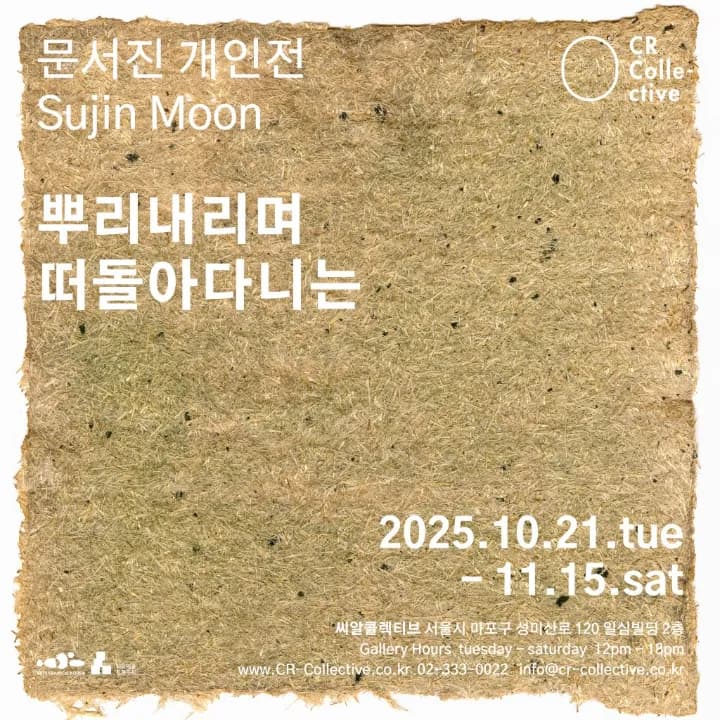
2025.10.21(tue) – 11.15(sat)
문서진 개인전 ≪뿌리내리며 떠돌아다니는≫
문서진(2025년 CR 신진작가지원 공모 선정)은 텃밭을 가꾸는 노동과 몸의 경험을 통해 소멸과 재생이 교차하는 리듬을 기록하고, 삶을 살아내는 생명 순환의 언어를 발화해왔다. 밭을 갈고 씨앗을 심고 열매를 거두는 반복의 경험은 개인적 서사를 넘어, 생태계의 순환과 그 속에서 인간이 위치하는 방식을 탐구하는 토대가 된다. 이번 전시 《뿌리내리며 떠돌아다니는》은 종이와 씨앗, 식물의 생애가 얽힌 물질적 구조 속에서, 인간과 자연, 죽음과 삶이 서로 매개하는 생태적 장면을 펼쳐낸다.
문서진의 작업에서 종이는 단순한 기록 매체가 아니라 생태적 장치이다. 건초를 분쇄해 만든 종이는 죽은 식물의 마지막 잔해이면서 동시에 비어 있는 여백이며, 다시 씨앗을 품어 발아함으로써 타자를 살리는 조건이 된다. 문서진의 종이는 죽음과 소멸의 잔해를 거부하거나 은폐하지 않고, 그것이야말로 새로운 생명을 가능케 하는 전환의 매개임을 드러낸다. 이때 종이는 단순한‘결과물’이 아니라, 죽음과 재생, 정착과 이동이 교차하는 생명 순환의 한 국면이자 관계적 차이를 드러내는 장치로 작동한다.〈한 장들 (Single Sheets)〉은 2021년부터 2025년까지 작가가 머문 장소에서 얻은 건초로 만든 종이들로, 특정한 시간과 장소를 품은 채 새로운 이야기를 기다리는 여백으로 제시된다.“종이가 시작과 끝을 가르는 시간의 마디라면”이라는 작가의 사유는 종이를 단순한 표면이 아니라 생애의 매듭, 순간의 단위로 바라보게 하면서 생태적 시간성을 드러낸다. 생태계의 시간은 직선적 진보가 아니라, 죽음과 생명을 가르는 수많은 단위들의 매듭으로 이루어진다. 종이는 결국 그 매듭을 물질적으로 시각화하는 장치이며, 인간이 그 속에서 위치하는 방식을 다시 질문하게 한다.
〈던져진 것들 (The Cast)〉은 씨앗이 심어진 종이를 전시장 벽에 던져 붙이는 행위에서 시작하며, 시간이 흐르며 종이 위의 씨앗은 싹을 틔운다. 이 작업은 생명이 개별적 실체로 존재하는 것이 아니라, 물과 빛, 표면, 환경과 얽히며 형성된다는 사실을 보여준다. 여기서 종이와 씨앗은 서로를 전제로 하며, 벽과 물, 시간과 함께 얽혀 새로운 생명을 생성한다. 즉, 생명은 고립된 주체가 아니라, 언제나 함께-만들기 속에서만 존재하는 것이다. 〈서 있는 것들 (The Standing)〉은 직립한 종이가 비와 이슬을 맞으며 무너지고, 그 자리에서 새로운 식물이 돋아나는 과정을 담는다. 죽은 식물의 몸은 종이로 서고, 다시 스러진 자리에서 생명이 솟는다. 종이는 죽음과 생명의 경계에 서서 수직과 수평, 상승과 하강의 긴장을 동시에 드러낸다. 다만, 이 장면에서 죽음은 단순한 소멸이 아니라 오히려 죽은 자가 산자를 살리는 타자성의 장면으로 드러난다. 무너진 종이는 자신을 소모함으로써 타자의 생명을 일으키며, 그 과정에서 죽음은 끝이 아니라 타자를 위한 조건으로 전환된다. 문서진의 작업은 이처럼 죽음과 삶이 단순히 대립하는 것이 아니라, 하나의 관계적 장 안에서 서로를 전환하며 나타남을 보여준다.
〈텃밭에서 (In the Garden)〉는 이러한 생태적 사유를 디지털 공간 속으로 확장한다. 이 작업은 마스트리히트 뒷마당 텃밭을 3D 스캐닝하여 구현한 인터랙티브 터치스크린 신작으로, 관객은 가상의 텃밭에 초대되어, 화면을 더듬으며 촉각적 사운드와 시 낭송의 목소리를 듣는다. 정체를 알 수 없는 소리들이 수군거리듯 들려오고, 특정 지점에 다가가면 목소리가 더 선명하게 울리면서, 텃밭을 가꾸는 일이 몸의 감각을 통해 터득되는 촉각적 이해의 과정으로 전환된다. 이 작업은 3D 스캐닝과 음성이라는 비물질적 형식을 통해 촉각성을 탐구하는데, 생태적 경험이 아날로그적 육체성에만 머무르지 않고, 디지털 기술 속에서도 관계와 감각의 얽힘을 통해 새롭게 생성될 수 있음을 보여준다. 이제 생태는 ‘자연’과 ‘인간’이라는 이항적 구조가 아니라, 기술적 매체와 인간의 감각, 비인간적 존재들이 협력적으로 얽혀 만들어내는 공동생산(sympoiesis)의 장이다.
마지막으로, 신작〈뿌리내리며 떠돌아다니는 것들 (Driftroot)〉은 패러글라이딩 퍼포머(실제 쌍둥이 자매)가 하늘에서 수제 종이를 흩뿌리는 장면을 기록한 퍼포먼스 영상이다. 종이는 하늘에서 흩날리다 땅에 닿아 사라지고, 며칠 뒤 그 자리에서 씨앗이 움튼다. 이 장면은 바흐친이 말한 죽음–재생의 경계를 허무는 카니발적 순환을 연상하게 하지만, 여기서 경험은 자연의 압도 앞에 무력한 인간의 숭고에 머물지 않는다. 오히려 인간과 자연이 서로의 차이를 매개로 맺는 관계적 공존의 장면으로 다가온다. 인간과 자연은 서로를 지배하거나 동일화하지 않고, 서로의 차이를 매개로 얽히며 함께-살아간다. 뿌려진 종이의 흩날림과 씨앗의 발아는 자연 속으로 흡수되는 것이 아니라, 생태계의 리듬 속에서 함께 호흡하며 살아가는 일이 된다. 패러글라이딩의 비상은 그러한 관계적 생애의 장을 드러내며, 인간과 자연이 서로를 비추는 순간적 카타르시스를 불러낸다.
전시는 제목처럼, 뿌리내리며 동시에 흩날리는 존재의 역동성을 보여준다. 씨앗과 열매가 분리된 것이 아니라 하나의 과정임을, 차이가 고립된 실체가 아니라 관계 속에서 생성된다는 사실을 관객 앞에 제시한다. 작가는, 우리는 어디에 뿌리내리며 떠돌고, 죽음의 자리에 솟아나는 생명은 어떤 방식으로 우리의 삶을 비추고 있는가를 묻고 있다. 이번 전시《뿌리내리며 떠돌아다니는》은 이 물음을 시각적·물질적 풍경으로 펼쳐내며, 모두가 종이처럼 생태계의 일부로서 끊임없이 사라지고 다시 태어나는 존재임을 일깨우고 있다.
Moon Sujin, selected for the 2025 CR Open Call for Emerging Aritsts, has documented rhythms where extinction and regeneration intersect through the labor of tending a garden and bodily experiences, articulating a language of life’s cyclical nature. The repetitive experience of plowing fields, planting seeds, and harvesting yields becomes a foundation that transcends personal narrative to explore the circulation of ecosystems and the ways humans are positioned within them. This exhibition, Driftroot, unfolds ecological scenes in which humans and nature, death and life mediate one another within the material structure where paper, seeds, and the lives of plants intertwine.
In Moon Sujin’s work, paper is not merely a recording medium but an ecological apparatus. Paper made from pulverized hay is simultaneously the final remnant of dead plants and an empty margin, becoming a condition that nurtures others by germinating seeds once again. Moon’s paper does not reject or conceal the remnants of death and extinction; rather, it reveals that these very remnants serve as mediators of transformation that enable new life. Here, paper operates not as a simple “product” but as a phase in the circulation of life where death and regeneration, settlement and movement intersect, and as an apparatus that reveals relational difference. Single Sheets presents papers made from hay gathered at locations where Moon stayed from 2021 to 2025, offered as margins that hold specific times and places while awaiting new stories. Moon’s contemplation—”if paper is a joint in time that divides beginning and end”—reveals ecological temporality by conceiving of paper not as a mere surface but as a knot of life, a unit of moments. Ecological time is not linear progress but is composed of countless units that divide death and life, forming knots. Paper ultimately serves as an apparatus that materially visualizes these knots, prompting us to question anew how humans are positioned within them.
The Cast begins with the act of throwing seed-embedded paper onto the exhibition wall, where over time the seeds on the paper sprout. This work demonstrates that life does not exist as an isolated entity but is formed through entanglement with water, light, surfaces, and environment. Here, paper and seeds presuppose one another, entangled with walls, water, and time to generate new life. In other words, life is not an isolated subject but exists only within making-with. The Standing I, II captures the process in which upright paper collapses under rain and dew, and new plants emerge from that very spot. The body of dead plants stands as paper, and life springs forth from where it has fallen. Paper stands at the boundary between death and life, simultaneously revealing the tensions of vertical and horizontal, ascent and descent. However, in this scene, death appears not as mere extinction but rather as a scene of alterity in which the dead sustain the living. Collapsed paper exhausts itself to raise the life of the other, and in this process, death is transformed not into an end but into a condition for the other. Moon Sujin’s work thus demonstrates that death and life do not simply oppose one another but appear as mutual transformations within a single relational field.
In the Garden extends this ecological thinking into digital space. This new interactive touchscreen work, created through 3D scanning of the backyard garden in Maastricht, invites viewers into a virtual garden where they grope across the screen while hearing tactile sounds and recited poetry. Indistinct sounds murmur, and as one approaches certain points, voices resonate more clearly, transforming the act of tending a garden into a process of tactile understanding acquired through bodily senses. This work explores tactility through the immaterial forms of 3D scanning and voice, demonstrating that ecological experience does not remain confined to analog corporeality but can be newly generated through the entanglement of relationships and senses within digital technology. Ecology is now not a binary structure of “nature” and “human” but a field of sympoiesis collaboratively woven by technological media, human senses, and nonhuman beings.
Finally, the new work Driftroot is a performance video documenting a scene in which paragliding performers (actual twin sisters) scatter handmade paper from the sky. The paper flutters in the air, touches the ground and disappears, and days later seeds sprout from that spot. This scene evokes the carnivalesque circulation that breaks down the death-regeneration boundary as described by Bakhtin, yet the experience here does not remain in the sublime of humanity rendered powerless before nature’s overwhelming force. Rather, it approaches as a scene of relational coexistence in which humans and nature form connections through their mutual difference. Humans and nature do not dominate or assimilate one another but become entangled through their differences, living-with. The scattering of thrown paper and the sprouting of seeds is not absorption into nature but becomes the act of breathing together within the rhythm of the ecosystem. The flight of paragliding reveals this field of relational life, summoning a momentary catharsis in which humans and nature reflect one another.
As the title suggests, the exhibition demonstrates the dynamism of existence that simultaneously takes root and scatters. It presents to viewers that seeds and fruits are not separate but one process, that difference is not an isolated entity but is generated within relationships. Moon asks: where do we take root while drifting, and in what ways does life that springs from the place of death illuminate our lives? This exhibition, Driftroot, unfolds these questions as a visual and material landscape, reminding us that all, like paper, are part of the ecosystem, ceaselessly disappearing and being reborn.
문서진 개인전 ≪뿌리내리며 떠돌아다니는≫
문서진(2025년 CR 신진작가지원 공모 선정)은 텃밭을 가꾸는 노동과 몸의 경험을 통해 소멸과 재생이 교차하는 리듬을 기록하고, 삶을 살아내는 생명 순환의 언어를 발화해왔다. 밭을 갈고 씨앗을 심고 열매를 거두는 반복의 경험은 개인적 서사를 넘어, 생태계의 순환과 그 속에서 인간이 위치하는 방식을 탐구하는 토대가 된다. 이번 전시 《뿌리내리며 떠돌아다니는》은 종이와 씨앗, 식물의 생애가 얽힌 물질적 구조 속에서, 인간과 자연, 죽음과 삶이 서로 매개하는 생태적 장면을 펼쳐낸다.
문서진의 작업에서 종이는 단순한 기록 매체가 아니라 생태적 장치이다. 건초를 분쇄해 만든 종이는 죽은 식물의 마지막 잔해이면서 동시에 비어 있는 여백이며, 다시 씨앗을 품어 발아함으로써 타자를 살리는 조건이 된다. 문서진의 종이는 죽음과 소멸의 잔해를 거부하거나 은폐하지 않고, 그것이야말로 새로운 생명을 가능케 하는 전환의 매개임을 드러낸다. 이때 종이는 단순한‘결과물’이 아니라, 죽음과 재생, 정착과 이동이 교차하는 생명 순환의 한 국면이자 관계적 차이를 드러내는 장치로 작동한다.〈한 장들 (Single Sheets)〉은 2021년부터 2025년까지 작가가 머문 장소에서 얻은 건초로 만든 종이들로, 특정한 시간과 장소를 품은 채 새로운 이야기를 기다리는 여백으로 제시된다.“종이가 시작과 끝을 가르는 시간의 마디라면”이라는 작가의 사유는 종이를 단순한 표면이 아니라 생애의 매듭, 순간의 단위로 바라보게 하면서 생태적 시간성을 드러낸다. 생태계의 시간은 직선적 진보가 아니라, 죽음과 생명을 가르는 수많은 단위들의 매듭으로 이루어진다. 종이는 결국 그 매듭을 물질적으로 시각화하는 장치이며, 인간이 그 속에서 위치하는 방식을 다시 질문하게 한다.
〈던져진 것들 (The Cast)〉은 씨앗이 심어진 종이를 전시장 벽에 던져 붙이는 행위에서 시작하며, 시간이 흐르며 종이 위의 씨앗은 싹을 틔운다. 이 작업은 생명이 개별적 실체로 존재하는 것이 아니라, 물과 빛, 표면, 환경과 얽히며 형성된다는 사실을 보여준다. 여기서 종이와 씨앗은 서로를 전제로 하며, 벽과 물, 시간과 함께 얽혀 새로운 생명을 생성한다. 즉, 생명은 고립된 주체가 아니라, 언제나 함께-만들기 속에서만 존재하는 것이다. 〈서 있는 것들 (The Standing)〉은 직립한 종이가 비와 이슬을 맞으며 무너지고, 그 자리에서 새로운 식물이 돋아나는 과정을 담는다. 죽은 식물의 몸은 종이로 서고, 다시 스러진 자리에서 생명이 솟는다. 종이는 죽음과 생명의 경계에 서서 수직과 수평, 상승과 하강의 긴장을 동시에 드러낸다. 다만, 이 장면에서 죽음은 단순한 소멸이 아니라 오히려 죽은 자가 산자를 살리는 타자성의 장면으로 드러난다. 무너진 종이는 자신을 소모함으로써 타자의 생명을 일으키며, 그 과정에서 죽음은 끝이 아니라 타자를 위한 조건으로 전환된다. 문서진의 작업은 이처럼 죽음과 삶이 단순히 대립하는 것이 아니라, 하나의 관계적 장 안에서 서로를 전환하며 나타남을 보여준다.
〈텃밭에서 (In the Garden)〉는 이러한 생태적 사유를 디지털 공간 속으로 확장한다. 이 작업은 마스트리히트 뒷마당 텃밭을 3D 스캐닝하여 구현한 인터랙티브 터치스크린 신작으로, 관객은 가상의 텃밭에 초대되어, 화면을 더듬으며 촉각적 사운드와 시 낭송의 목소리를 듣는다. 정체를 알 수 없는 소리들이 수군거리듯 들려오고, 특정 지점에 다가가면 목소리가 더 선명하게 울리면서, 텃밭을 가꾸는 일이 몸의 감각을 통해 터득되는 촉각적 이해의 과정으로 전환된다. 이 작업은 3D 스캐닝과 음성이라는 비물질적 형식을 통해 촉각성을 탐구하는데, 생태적 경험이 아날로그적 육체성에만 머무르지 않고, 디지털 기술 속에서도 관계와 감각의 얽힘을 통해 새롭게 생성될 수 있음을 보여준다. 이제 생태는 ‘자연’과 ‘인간’이라는 이항적 구조가 아니라, 기술적 매체와 인간의 감각, 비인간적 존재들이 협력적으로 얽혀 만들어내는 공동생산(sympoiesis)의 장이다.
마지막으로, 신작〈뿌리내리며 떠돌아다니는 것들 (Driftroot)〉은 패러글라이딩 퍼포머(실제 쌍둥이 자매)가 하늘에서 수제 종이를 흩뿌리는 장면을 기록한 퍼포먼스 영상이다. 종이는 하늘에서 흩날리다 땅에 닿아 사라지고, 며칠 뒤 그 자리에서 씨앗이 움튼다. 이 장면은 바흐친이 말한 죽음–재생의 경계를 허무는 카니발적 순환을 연상하게 하지만, 여기서 경험은 자연의 압도 앞에 무력한 인간의 숭고에 머물지 않는다. 오히려 인간과 자연이 서로의 차이를 매개로 맺는 관계적 공존의 장면으로 다가온다. 인간과 자연은 서로를 지배하거나 동일화하지 않고, 서로의 차이를 매개로 얽히며 함께-살아간다. 뿌려진 종이의 흩날림과 씨앗의 발아는 자연 속으로 흡수되는 것이 아니라, 생태계의 리듬 속에서 함께 호흡하며 살아가는 일이 된다. 패러글라이딩의 비상은 그러한 관계적 생애의 장을 드러내며, 인간과 자연이 서로를 비추는 순간적 카타르시스를 불러낸다.
전시는 제목처럼, 뿌리내리며 동시에 흩날리는 존재의 역동성을 보여준다. 씨앗과 열매가 분리된 것이 아니라 하나의 과정임을, 차이가 고립된 실체가 아니라 관계 속에서 생성된다는 사실을 관객 앞에 제시한다. 작가는, 우리는 어디에 뿌리내리며 떠돌고, 죽음의 자리에 솟아나는 생명은 어떤 방식으로 우리의 삶을 비추고 있는가를 묻고 있다. 이번 전시《뿌리내리며 떠돌아다니는》은 이 물음을 시각적·물질적 풍경으로 펼쳐내며, 모두가 종이처럼 생태계의 일부로서 끊임없이 사라지고 다시 태어나는 존재임을 일깨우고 있다.
Moon Sujin, selected for the 2025 CR Open Call for Emerging Aritsts, has documented rhythms where extinction and regeneration intersect through the labor of tending a garden and bodily experiences, articulating a language of life’s cyclical nature. The repetitive experience of plowing fields, planting seeds, and harvesting yields becomes a foundation that transcends personal narrative to explore the circulation of ecosystems and the ways humans are positioned within them. This exhibition, Driftroot, unfolds ecological scenes in which humans and nature, death and life mediate one another within the material structure where paper, seeds, and the lives of plants intertwine.
In Moon Sujin’s work, paper is not merely a recording medium but an ecological apparatus. Paper made from pulverized hay is simultaneously the final remnant of dead plants and an empty margin, becoming a condition that nurtures others by germinating seeds once again. Moon’s paper does not reject or conceal the remnants of death and extinction; rather, it reveals that these very remnants serve as mediators of transformation that enable new life. Here, paper operates not as a simple “product” but as a phase in the circulation of life where death and regeneration, settlement and movement intersect, and as an apparatus that reveals relational difference. Single Sheets presents papers made from hay gathered at locations where Moon stayed from 2021 to 2025, offered as margins that hold specific times and places while awaiting new stories. Moon’s contemplation—”if paper is a joint in time that divides beginning and end”—reveals ecological temporality by conceiving of paper not as a mere surface but as a knot of life, a unit of moments. Ecological time is not linear progress but is composed of countless units that divide death and life, forming knots. Paper ultimately serves as an apparatus that materially visualizes these knots, prompting us to question anew how humans are positioned within them.
The Cast begins with the act of throwing seed-embedded paper onto the exhibition wall, where over time the seeds on the paper sprout. This work demonstrates that life does not exist as an isolated entity but is formed through entanglement with water, light, surfaces, and environment. Here, paper and seeds presuppose one another, entangled with walls, water, and time to generate new life. In other words, life is not an isolated subject but exists only within making-with. The Standing I, II captures the process in which upright paper collapses under rain and dew, and new plants emerge from that very spot. The body of dead plants stands as paper, and life springs forth from where it has fallen. Paper stands at the boundary between death and life, simultaneously revealing the tensions of vertical and horizontal, ascent and descent. However, in this scene, death appears not as mere extinction but rather as a scene of alterity in which the dead sustain the living. Collapsed paper exhausts itself to raise the life of the other, and in this process, death is transformed not into an end but into a condition for the other. Moon Sujin’s work thus demonstrates that death and life do not simply oppose one another but appear as mutual transformations within a single relational field.
In the Garden extends this ecological thinking into digital space. This new interactive touchscreen work, created through 3D scanning of the backyard garden in Maastricht, invites viewers into a virtual garden where they grope across the screen while hearing tactile sounds and recited poetry. Indistinct sounds murmur, and as one approaches certain points, voices resonate more clearly, transforming the act of tending a garden into a process of tactile understanding acquired through bodily senses. This work explores tactility through the immaterial forms of 3D scanning and voice, demonstrating that ecological experience does not remain confined to analog corporeality but can be newly generated through the entanglement of relationships and senses within digital technology. Ecology is now not a binary structure of “nature” and “human” but a field of sympoiesis collaboratively woven by technological media, human senses, and nonhuman beings.
Finally, the new work Driftroot is a performance video documenting a scene in which paragliding performers (actual twin sisters) scatter handmade paper from the sky. The paper flutters in the air, touches the ground and disappears, and days later seeds sprout from that spot. This scene evokes the carnivalesque circulation that breaks down the death-regeneration boundary as described by Bakhtin, yet the experience here does not remain in the sublime of humanity rendered powerless before nature’s overwhelming force. Rather, it approaches as a scene of relational coexistence in which humans and nature form connections through their mutual difference. Humans and nature do not dominate or assimilate one another but become entangled through their differences, living-with. The scattering of thrown paper and the sprouting of seeds is not absorption into nature but becomes the act of breathing together within the rhythm of the ecosystem. The flight of paragliding reveals this field of relational life, summoning a momentary catharsis in which humans and nature reflect one another.
As the title suggests, the exhibition demonstrates the dynamism of existence that simultaneously takes root and scatters. It presents to viewers that seeds and fruits are not separate but one process, that difference is not an isolated entity but is generated within relationships. Moon asks: where do we take root while drifting, and in what ways does life that springs from the place of death illuminate our lives? This exhibition, Driftroot, unfolds these questions as a visual and material landscape, reminding us that all, like paper, are part of the ecosystem, ceaselessly disappearing and being reborn.
| 작가 | 문서진 |
| 전시장 | 씨알콜렉티브 (CR Collective, シーアール・コレクティブ) |
| 주소 | 03988 서울특별시 마포구 성미산로 120 일심빌딩 2층주소 복사하기복사 |
| 오시는 길 | 서울 지하철 2호선 홍대입구역 2번 출구에서 도보 15분. 혹은 06번 마을버스를 타고 정류장 – '경성중고, 홍익디자인고등학교앞' 에서 하차. |
| 기간 | 2025.10.21(화) - 11.15(토) |
| 관람시간 | 12:00 - 18:00 |
| 휴일 | 일요일, 월요일, 공휴일 |
| SNS |  |
| 웹사이트 |