
이재이 개인전 《All That Glitters, All That Flickers》
씨알콜렉티브
2025.08.26(화) - 09.27(토)
이 이벤트는은 휴일입니다
※상세·최신 정보는 이벤트의 공식 사이트를 확인해 주세요.
MAP
SHARE

이벤트 정보 복사하기복사
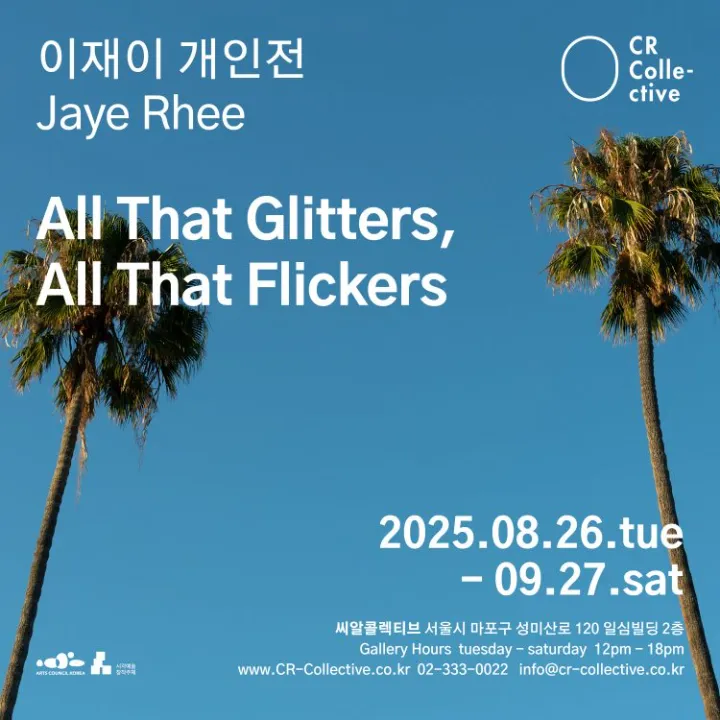
2025.08.26(tue) – 09.27(sat) 이재이 개인전 ≪All That Glitters, All That Flickers≫
2025년 6월 27일씨알 복합문화공간 CR Cultural Complex 0 0
이재이의 작업은 현실과 환영의 경계에서 시공간을 횡단하며, 사회·문화적 맥락의 파편과 아이러니를 소환한다. 그의 영상은 단일한 시공간에 고정되지 않고, 기억의 잔여와 기술 매체의 흔적, 도시적 이미지가 교차하는 지점에서 진동하며 생성된다. 초기 작업에서부터 최근의 사운드 퍼포먼스에 이르기까지, 그는 촬영과 편집, 매체 간 전환을 통해 이미지와 신체, 소리와 장소 사이에서 작용하는 감각의 정동과 매체의 경계를 탐구해왔다.
이번 개인전 《All That Glitters, All That Flickers》는 작가가 오랜 기간 천착해 온 도시 이미지와 매체 형식의 심층적 구조에 주목한다. 전시는 20세기 중반 미래주의적 시각 언어와 그 잔재가 어떻게 오늘날 감각적 장면으로 재구성되고, 탈맥락화된 상태로 유통되는지를 개인적 서사와 매체 실험을 통해 탐색한다. 이재이는 복고적인 미래 상상력과 도시적 디스플레이의 장치성, 낡은 매체의 물성과 감정적 잔광을 호출하며, 과거 유토피아가 남긴 ‘반짝이고 깜박이는’ 이미지들이 단순한 회상으로 소비되는 대신, 지워진 감각을 활성화하고 무상의 정서를 통해 존재의 방식을 드러낸다.
전시는 싱글 채널 영상 〈All That Glitters All That Flickers〉, 샹송 가수의 목소리로 윤심덕의 〈사의 찬미〉를 소환한 〈Pulse and Stillness〉, 이미지가 제거된 16mm 공필름을 반복 투사하는 〈Every Frame is a Farewell〉, 그리고 우편엽서 크기의 사진 프린트로 구성된다. 이 가운데 신작 〈All That Glitters All That Flickers〉에서 작가가 주목하는 ‘반짝임’과 ‘깜빡임’은 단순한 미학적 장치가 아니라, 산업화 이후 도시 이미지의 기반을 형성한 특정 시대의 유토피아적 시각 언어이다. 작가가 참조하는 구기 아키텍처(Googie Architecture)는 1940 후기부터 70년대 초기까지 미국 서부에서 등장한 양식으로, 네온 조명과 유선형 구조, 스테인리스 재질과 대형 사이니지 등을 통해 미래에 대한 낙관적 기대를 시각화했다. 이 양식은 원자력 시대의 진보 신화, 고속도로 건설과 자동차 중심의 도시 구조, 우주 경쟁과 결부되며 당대의 물질적 풍요를 상징했으나, 오늘날에는 더 이상 미래를 상징하지 못한 채 진부한 기호와 문화적 유물로 남았다. 이재이는 바로 이 ‘과거의 미래’가 남긴 탈맥락적 이미지와 감각의 잔여를 추적한다. 그리고 그 위에 고인이 된 아버지와 가족의 기억을 포개어 내레이션함으로써, 감상적 노스탤지어를 넘어 사라진 과거의 부재를 의식하는 행위로 전환한다.
작가의 매체 실험은 단순한 형식적 선택이 아니라, 부재와 시간성을 드러내는 전략이다. 디지털 타임랩스 스틸과 영상을 VHS와 16mm 필름으로 전환하는 것은 기술 진보의 역행이 아니라 각기 다른 감각적 층위를 탐색하는 과정이다. 특히 필름 위에 직접 드로잉을 더하거나 망점을 클로즈-업으로 노출하는 개입은, 매체를 단순한 전달 수단이 아니라 기억과 감정이 퇴적된 지층으로 제시한다. 동시에 매체는 예술작품의 결과물이자 소비 가능한 물질로 기능하며, 작가는 이를 감각적 잔여·이미지의 수신·물리적 흔적이라는 차원에서 재사유한다. 〈Every Frame is a Farewell〉은 이미지가 제거된 필름을 투사하는 행위를 통해, 존재하지 않는 이미지를 반복 상영함으로써 부재와 사라짐의 정서를 환기한다. 이는 단순히 ‘회상된 과거’를 되살리는 것이 아니라, 회상할 수 없는 것 자체의 흔적을 감각하게 한다.
이러한 전략은 그의 초기 작업에서도 맥락을 찾을 수 있다. 2009년 갤러리 팩토리 개인전에서 그는 한국 목욕탕 벽화 속 백조와 수건을 머리에 두른 인물을 병치한 영상을 통해, 서구 낭만주의의 표상이 한국적 일상 속에서 어떻게 희화되고 키치화되는지를 비판적으로 제시했다. 당시의 백조가 실제 호수가 아닌 타일 벽 위에 그려져 있듯, 이번 전시의 도시적 반짝임 또한 ‘낙원의 표상’이 탈맥락화된 흔적으로만 남아 있음을 드러낸다.
〈Pulse and Stillness〉는 윤심덕의 노래 〈사의 찬미〉를 오늘날 다시 호출한다. 1926년 발표된 이 곡은 루마니아 작곡가 이오시프 이바노비치(Iosif Ivanovici)의 <도나우의 잔물결(Donauwellen)>을 일본을 거쳐 한국에서 번안한 최초의 대중가요로, 허무주의적 인생관과 식민지적 모순이 교차하는 정서를 담고 있다. 이재이는 이를 붉은 막과 반짝이는 미러볼로 펼쳐내고, 암전으로 시작과 마지막을 장식하면서 인간 존재의 유한성과 불가역성을 극화한다. 이와 함께 <FOREVER>는 텍스트 작업으로, 관람자는 점멸(漸滅)해가는 ‘영원’을 벽면에서 찾아볼 수 있다.
《All That Glitters, All That Flickers》는 과거를 향한 감상적 회상이나 복고적 양식의 수집에 머물지 않는다. 오히려 ‘반짝임’이라는 장치의 본질적 속성—곧 오래 지속되지 않고 곧 사라지는 성질—을 환기하며, 실현되지 못한 진보와 유예된 낙원의 허상을 되묻는다. 이는 20세기 중반의 유토피아적 미래 이미지가 실현되지 못하고 남긴 허상성과 닮아있다. 구현되지 않은 진보, 유예된 낙원, 장식된 디스플레이는 오늘날 더욱 선명하게 그 불가능성을 드러낸다. 이재이는 이러한 허상을 단순히 고발하거나 해체하지 않고, 대신 부재를 감각하는 순간을 통해 남겨진 감각적 잔여에 주목한다. 곡선과 표면, 필름의 흔들림, 지워진 이미지 위에 덧입혀진 흔적은 감정의 결을 따라 재배치되며, 사라진 유토피아와 여전히 반짝이는 현재 사이의 간극을 드러낸다. 이번 전시는 바로 그 간극을 감각적으로 탐색하며, 부재의 존재론적 진실을 예술적 체험으로 제시하고 있다.
Jaye Rhee’s artistic practice traverses time and space at the boundary between reality and illusion, drawing fragments and ironies from social and cultural contexts. Her videos are not confined to any single moment or place. Instead, they vibrate and emerge where remnants of memory, technological traces, and urban imagery converge. From her early works to recent sound performances, she has explored the affect of sensation and intermedial boundaries through filming, editing, and intermedial transitions. This exploration focuses on how these elements operate between image and body, sound and place.
This solo exhibition, All That Glitters, All That Flickers, examines the deep structural dimensions of urban imagery and media formats that Rhee has long investigated. The exhibition explores how mid-20th century futuristic visual languages and their remnants are reconstructed into contemporary sensory scenes and circulated in decontextualized states. This exploration develops through personal narratives and media experimentation. Jaye Rhee invokes retro-futuristic imagination, urban displays as apparatus, and the materiality and emotional afterglow of obsolete media. Rather than simply treating the “glittering and flickering” images left by past utopias as nostalgic objects, she activates erased sensations. Through emotions of impermanence, she reveals new ways of being.
The exhibition comprises the single-channel video All That Glitters All That Flickers, Pulse and Stillness which summons Yun Sim-deok’s Praise of Death through a chanson singer’s voice, Every Frame is a Farewell which repeatedly projects image-removed 16mm blank film, and photographic prints in postcard format. Among these, the new work All That Glitters All That Flickers presents “glittering” and “flickering” not as simple aesthetic devices, but as utopian visual languages of a specific era that formed the foundation of urban imagery after industrialization. Rhee references Googie Architecture, a style that emerged in the American West from the late 1940s to early 1970s. It visualized optimistic expectations of the future through neon lighting, streamlined structures, stainless steel materials, and large-scale signage. Connected to atomic age progress myths, highway construction, automobile-centered urban structures, and space competition, this style symbolized the material prosperity of its era. Today, however, it no longer represents the future but survives only as hackneyed symbols and cultural relics. Jaye Rhee traces precisely these decontextualized images and sensory remnants left by this “past future.” She interweaves memories of her deceased father and family with these narratives, moving beyond sentimental nostalgia to confront the absence of what has been lost.
Rhee’s media experimentation is not merely formal choice but a strategy for revealing absence and temporality. Converting digital time-lapse stills and videos to VHS and 16mm film is not a regression of technological progress. Rather, it is a process of exploring different sensory layers. In particular, her interventions—such as adding direct drawings onto film or exposing halftone dots in close-ups—present media not as simple transmission tools but as layered deposits of memory and emotion accumulated over time. Simultaneously, media functions both as artistic product and consumable material. Rhee reconsiders this multifaceted nature in terms of remnants of sensation, image reception, and physical trace. Every Frame is a Farewell evokes emotions of absence and disappearance through the act of projecting image-removed film—an act that becomes the repeated screening of nonexistent images. This does not simply revive the “remembered past” but allows us to sense traces of what lies beyond memory itself.
This strategy has roots in her early work. In her 2009 solo exhibition at Gallery Factory, she critically examined how representations of Western romanticism are parodied and kitschified within Korean everyday life through a video juxtaposing swans from Korean bathhouse murals with figures wearing towels on their heads. Just as the swans of that time were painted not on actual lakes but on tiled walls, the urban glittering in this exhibition reveals that “representations of paradise” remain only as decontextualized traces.
Pulse and Stillness recalls Yun Sim-deok’s song Praise of Death in the present day. Released in 1926, this song was the first popular Korean song adapted from Romanian composer Iosif Ivanovici’s Donauwellen via Japan, capturing the clash between nihilistic philosophy and colonial tensions. Jaye Rhee presents this work with red curtains and glittering mirror balls, opening and closing with blackouts to heighten the finitude and irreversibility of human existence. FOREVER is a text work in which viewers encounter ‘eternity’ slowly deteriorating into disappearance on the wall.
All That Glitters, All That Flickers avoids nostalgic sentimentality or mere retro aesthetics. Instead, it evokes the inherent nature of “glittering”—something ephemeral that quickly fades—to question illusions of failed progress and postponed utopias. This mirrors how mid-20th century visions of the future now appear hollow and unrealized. Today, unfulfilled promises of progress, deferred paradise, and ornamental displays expose their own impossibility more starkly than ever. Rather than simply exposing or deconstructing these illusions, Rhee focuses on the remnants of sensation left behind through moments of perceiving absence. Curves and surfaces, the tremor of film, and traces layered over erased images are rearranged according to emotional patterns, revealing the gap between vanished utopia and our still-glittering present. This exhibition explores that very gap, presenting absence as a lived reality through artistic experience.
2025년 6월 27일씨알 복합문화공간 CR Cultural Complex 0 0
이재이의 작업은 현실과 환영의 경계에서 시공간을 횡단하며, 사회·문화적 맥락의 파편과 아이러니를 소환한다. 그의 영상은 단일한 시공간에 고정되지 않고, 기억의 잔여와 기술 매체의 흔적, 도시적 이미지가 교차하는 지점에서 진동하며 생성된다. 초기 작업에서부터 최근의 사운드 퍼포먼스에 이르기까지, 그는 촬영과 편집, 매체 간 전환을 통해 이미지와 신체, 소리와 장소 사이에서 작용하는 감각의 정동과 매체의 경계를 탐구해왔다.
이번 개인전 《All That Glitters, All That Flickers》는 작가가 오랜 기간 천착해 온 도시 이미지와 매체 형식의 심층적 구조에 주목한다. 전시는 20세기 중반 미래주의적 시각 언어와 그 잔재가 어떻게 오늘날 감각적 장면으로 재구성되고, 탈맥락화된 상태로 유통되는지를 개인적 서사와 매체 실험을 통해 탐색한다. 이재이는 복고적인 미래 상상력과 도시적 디스플레이의 장치성, 낡은 매체의 물성과 감정적 잔광을 호출하며, 과거 유토피아가 남긴 ‘반짝이고 깜박이는’ 이미지들이 단순한 회상으로 소비되는 대신, 지워진 감각을 활성화하고 무상의 정서를 통해 존재의 방식을 드러낸다.
전시는 싱글 채널 영상 〈All That Glitters All That Flickers〉, 샹송 가수의 목소리로 윤심덕의 〈사의 찬미〉를 소환한 〈Pulse and Stillness〉, 이미지가 제거된 16mm 공필름을 반복 투사하는 〈Every Frame is a Farewell〉, 그리고 우편엽서 크기의 사진 프린트로 구성된다. 이 가운데 신작 〈All That Glitters All That Flickers〉에서 작가가 주목하는 ‘반짝임’과 ‘깜빡임’은 단순한 미학적 장치가 아니라, 산업화 이후 도시 이미지의 기반을 형성한 특정 시대의 유토피아적 시각 언어이다. 작가가 참조하는 구기 아키텍처(Googie Architecture)는 1940 후기부터 70년대 초기까지 미국 서부에서 등장한 양식으로, 네온 조명과 유선형 구조, 스테인리스 재질과 대형 사이니지 등을 통해 미래에 대한 낙관적 기대를 시각화했다. 이 양식은 원자력 시대의 진보 신화, 고속도로 건설과 자동차 중심의 도시 구조, 우주 경쟁과 결부되며 당대의 물질적 풍요를 상징했으나, 오늘날에는 더 이상 미래를 상징하지 못한 채 진부한 기호와 문화적 유물로 남았다. 이재이는 바로 이 ‘과거의 미래’가 남긴 탈맥락적 이미지와 감각의 잔여를 추적한다. 그리고 그 위에 고인이 된 아버지와 가족의 기억을 포개어 내레이션함으로써, 감상적 노스탤지어를 넘어 사라진 과거의 부재를 의식하는 행위로 전환한다.
작가의 매체 실험은 단순한 형식적 선택이 아니라, 부재와 시간성을 드러내는 전략이다. 디지털 타임랩스 스틸과 영상을 VHS와 16mm 필름으로 전환하는 것은 기술 진보의 역행이 아니라 각기 다른 감각적 층위를 탐색하는 과정이다. 특히 필름 위에 직접 드로잉을 더하거나 망점을 클로즈-업으로 노출하는 개입은, 매체를 단순한 전달 수단이 아니라 기억과 감정이 퇴적된 지층으로 제시한다. 동시에 매체는 예술작품의 결과물이자 소비 가능한 물질로 기능하며, 작가는 이를 감각적 잔여·이미지의 수신·물리적 흔적이라는 차원에서 재사유한다. 〈Every Frame is a Farewell〉은 이미지가 제거된 필름을 투사하는 행위를 통해, 존재하지 않는 이미지를 반복 상영함으로써 부재와 사라짐의 정서를 환기한다. 이는 단순히 ‘회상된 과거’를 되살리는 것이 아니라, 회상할 수 없는 것 자체의 흔적을 감각하게 한다.
이러한 전략은 그의 초기 작업에서도 맥락을 찾을 수 있다. 2009년 갤러리 팩토리 개인전에서 그는 한국 목욕탕 벽화 속 백조와 수건을 머리에 두른 인물을 병치한 영상을 통해, 서구 낭만주의의 표상이 한국적 일상 속에서 어떻게 희화되고 키치화되는지를 비판적으로 제시했다. 당시의 백조가 실제 호수가 아닌 타일 벽 위에 그려져 있듯, 이번 전시의 도시적 반짝임 또한 ‘낙원의 표상’이 탈맥락화된 흔적으로만 남아 있음을 드러낸다.
〈Pulse and Stillness〉는 윤심덕의 노래 〈사의 찬미〉를 오늘날 다시 호출한다. 1926년 발표된 이 곡은 루마니아 작곡가 이오시프 이바노비치(Iosif Ivanovici)의 <도나우의 잔물결(Donauwellen)>을 일본을 거쳐 한국에서 번안한 최초의 대중가요로, 허무주의적 인생관과 식민지적 모순이 교차하는 정서를 담고 있다. 이재이는 이를 붉은 막과 반짝이는 미러볼로 펼쳐내고, 암전으로 시작과 마지막을 장식하면서 인간 존재의 유한성과 불가역성을 극화한다. 이와 함께 <FOREVER>는 텍스트 작업으로, 관람자는 점멸(漸滅)해가는 ‘영원’을 벽면에서 찾아볼 수 있다.
《All That Glitters, All That Flickers》는 과거를 향한 감상적 회상이나 복고적 양식의 수집에 머물지 않는다. 오히려 ‘반짝임’이라는 장치의 본질적 속성—곧 오래 지속되지 않고 곧 사라지는 성질—을 환기하며, 실현되지 못한 진보와 유예된 낙원의 허상을 되묻는다. 이는 20세기 중반의 유토피아적 미래 이미지가 실현되지 못하고 남긴 허상성과 닮아있다. 구현되지 않은 진보, 유예된 낙원, 장식된 디스플레이는 오늘날 더욱 선명하게 그 불가능성을 드러낸다. 이재이는 이러한 허상을 단순히 고발하거나 해체하지 않고, 대신 부재를 감각하는 순간을 통해 남겨진 감각적 잔여에 주목한다. 곡선과 표면, 필름의 흔들림, 지워진 이미지 위에 덧입혀진 흔적은 감정의 결을 따라 재배치되며, 사라진 유토피아와 여전히 반짝이는 현재 사이의 간극을 드러낸다. 이번 전시는 바로 그 간극을 감각적으로 탐색하며, 부재의 존재론적 진실을 예술적 체험으로 제시하고 있다.
Jaye Rhee’s artistic practice traverses time and space at the boundary between reality and illusion, drawing fragments and ironies from social and cultural contexts. Her videos are not confined to any single moment or place. Instead, they vibrate and emerge where remnants of memory, technological traces, and urban imagery converge. From her early works to recent sound performances, she has explored the affect of sensation and intermedial boundaries through filming, editing, and intermedial transitions. This exploration focuses on how these elements operate between image and body, sound and place.
This solo exhibition, All That Glitters, All That Flickers, examines the deep structural dimensions of urban imagery and media formats that Rhee has long investigated. The exhibition explores how mid-20th century futuristic visual languages and their remnants are reconstructed into contemporary sensory scenes and circulated in decontextualized states. This exploration develops through personal narratives and media experimentation. Jaye Rhee invokes retro-futuristic imagination, urban displays as apparatus, and the materiality and emotional afterglow of obsolete media. Rather than simply treating the “glittering and flickering” images left by past utopias as nostalgic objects, she activates erased sensations. Through emotions of impermanence, she reveals new ways of being.
The exhibition comprises the single-channel video All That Glitters All That Flickers, Pulse and Stillness which summons Yun Sim-deok’s Praise of Death through a chanson singer’s voice, Every Frame is a Farewell which repeatedly projects image-removed 16mm blank film, and photographic prints in postcard format. Among these, the new work All That Glitters All That Flickers presents “glittering” and “flickering” not as simple aesthetic devices, but as utopian visual languages of a specific era that formed the foundation of urban imagery after industrialization. Rhee references Googie Architecture, a style that emerged in the American West from the late 1940s to early 1970s. It visualized optimistic expectations of the future through neon lighting, streamlined structures, stainless steel materials, and large-scale signage. Connected to atomic age progress myths, highway construction, automobile-centered urban structures, and space competition, this style symbolized the material prosperity of its era. Today, however, it no longer represents the future but survives only as hackneyed symbols and cultural relics. Jaye Rhee traces precisely these decontextualized images and sensory remnants left by this “past future.” She interweaves memories of her deceased father and family with these narratives, moving beyond sentimental nostalgia to confront the absence of what has been lost.
Rhee’s media experimentation is not merely formal choice but a strategy for revealing absence and temporality. Converting digital time-lapse stills and videos to VHS and 16mm film is not a regression of technological progress. Rather, it is a process of exploring different sensory layers. In particular, her interventions—such as adding direct drawings onto film or exposing halftone dots in close-ups—present media not as simple transmission tools but as layered deposits of memory and emotion accumulated over time. Simultaneously, media functions both as artistic product and consumable material. Rhee reconsiders this multifaceted nature in terms of remnants of sensation, image reception, and physical trace. Every Frame is a Farewell evokes emotions of absence and disappearance through the act of projecting image-removed film—an act that becomes the repeated screening of nonexistent images. This does not simply revive the “remembered past” but allows us to sense traces of what lies beyond memory itself.
This strategy has roots in her early work. In her 2009 solo exhibition at Gallery Factory, she critically examined how representations of Western romanticism are parodied and kitschified within Korean everyday life through a video juxtaposing swans from Korean bathhouse murals with figures wearing towels on their heads. Just as the swans of that time were painted not on actual lakes but on tiled walls, the urban glittering in this exhibition reveals that “representations of paradise” remain only as decontextualized traces.
Pulse and Stillness recalls Yun Sim-deok’s song Praise of Death in the present day. Released in 1926, this song was the first popular Korean song adapted from Romanian composer Iosif Ivanovici’s Donauwellen via Japan, capturing the clash between nihilistic philosophy and colonial tensions. Jaye Rhee presents this work with red curtains and glittering mirror balls, opening and closing with blackouts to heighten the finitude and irreversibility of human existence. FOREVER is a text work in which viewers encounter ‘eternity’ slowly deteriorating into disappearance on the wall.
All That Glitters, All That Flickers avoids nostalgic sentimentality or mere retro aesthetics. Instead, it evokes the inherent nature of “glittering”—something ephemeral that quickly fades—to question illusions of failed progress and postponed utopias. This mirrors how mid-20th century visions of the future now appear hollow and unrealized. Today, unfulfilled promises of progress, deferred paradise, and ornamental displays expose their own impossibility more starkly than ever. Rather than simply exposing or deconstructing these illusions, Rhee focuses on the remnants of sensation left behind through moments of perceiving absence. Curves and surfaces, the tremor of film, and traces layered over erased images are rearranged according to emotional patterns, revealing the gap between vanished utopia and our still-glittering present. This exhibition explores that very gap, presenting absence as a lived reality through artistic experience.
| 작가 | 이재이 |
| 전시장 | 씨알콜렉티브 (CR Collective, シーアール・コレクティブ) |
| 주소 | 03988 서울특별시 마포구 성미산로 120 일심빌딩 2층주소 복사하기복사 |
| 오시는 길 | 서울 지하철 2호선 홍대입구역 2번 출구에서 도보 15분. 혹은 06번 마을버스를 타고 정류장 – '경성중고, 홍익디자인고등학교앞' 에서 하차. |
| 기간 | 2025.08.26(화) - 09.27(토) |
| 관람시간 | 12:00 - 18:00 |
| 휴일 | 일요일, 월요일, 공휴일 |
| SNS |  |
| 웹사이트 |