
선으로, 동작으로, 허공으로
파이프갤러리
2025.05.07(수) - 31(토)
이 이벤트는은 휴일입니다
※상세·최신 정보는 이벤트의 공식 사이트를 확인해 주세요.
MAP
SHARE

이벤트 정보 복사하기복사
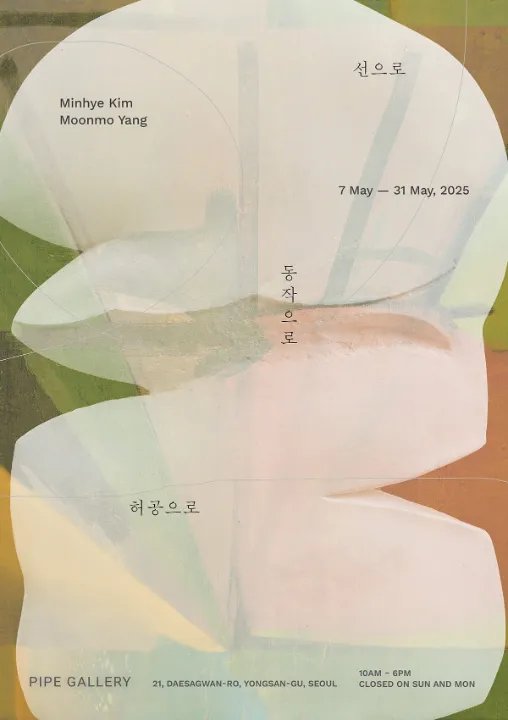
선으로 동작으로 허공으로
2025. 5.7 - 2025. 5.31
파이프갤러리는 5월 7일부터 5월 31일까지 김민혜, 양문모 작가의 2인전 《선으로 동작으로 허공으로》를 개최한다.
김민혜와 양문모는 선과 동작, 그리고 허공의 경계를 탐색한다. 이들은 형태를 구축하거나 재현하기보다, 그것이 무너지고 다시 세워지는 과정을 기록한다. 선은 움직임을 따라 흔들리고, 동작은 형태를 지우며, 허공은 부재와 존재 사이의 틈을 드러낸다. 이 세 가지 요소는 고정된 결과물이 아니라, 끊임없이 변화하는 과정 자체를 드러내는 매개가 된다.
김민혜(b.1986)는 평면 위에 선과 면을 겹치며 깊이를 만들어낸다. 그녀는 재현적 이미지의 무게를 벗어나, 선과 면의 관계를 통해 공간적 감각을 확장한다. 물성이나 구체적 대상을 강조하기보다는, 비워진 공간과 그 너머를 감각적으로 지시한다. 드로잉과 조각 사이를 넘나드는 그녀의 작업은, 경계에 머무르며 열린 구조를 지향한다.
양문모(b.1986)는 반복과 삭제를 통해 회화의 재현성을 질문한다. 드로잉에서 시작된 그의 작업은, 화면 위를 흐르는 손의 움직임과 소거의 몸짓을 통해 공간을 다시 구축한다. 그는 고정된 이미지를 완성하는 대신, 손과 몸의 흔적을 통해 생성과 소멸의 과정을 드러낸다. 화면은 완결된 장면이 아니라, 끝없이 수정되고 갱신되는 현장으로 제시된다.
두 작가는 각기 다른 매체를 다루지만, 모두 불완전한 형태와 열린 구조를 지향한다. 선은 고정된 윤곽이 아니라 흐름이 되고, 동작은 화면을 덮는 동시에 밀어낸다. 이들은 형상과 비형상 사이의 경계를 흐리면서, 감각적이고 유동적인 공간을 만들어낸다. 허공은 이 모든 과정이 남긴 흔적이며, 사라짐과 생성이 교차하는 자리이자, 또 다른 가능성이 열리는 지점이다.
《선으로, 동작으로, 허공으로》는 두 작가의 대화이자, 시간과 공간을 관통하는 손의 기록이다. 이 전시는 고정된 서사를 따르지 않고, 관객 각자의 시선 안에서 끊임없이 열리고 닫히는 하나의 장으로 남을 것이다. 관객은 완성된 결과가 아니라, 그 과정 속에서 드러나는 움직임과 흔적을 따라가며 전시를 경험하게 된다.
Pipe Gallery is pleased to present 《In line, movement and air》, a two-person exhibition featuring works by Minhye Kim and Moonmo Yang, on view from May 7 through May 31.
The two artists explore the thresholds between line, gesture, and air. Rather than constructing or reproducing form, they trace the process through which form collapses and is reconstituted. The line trembles along with movement, gesture erases form, and air reveals the interval between presence and absence. These three elements are not fixed endpoints, but rather mediators that expose a process in constant flux.
Minhye Kim(b.1986) creates depth by layering lines and planes upon a surface. Departing from the weight of representational imagery, she extends a spatial sensibility through the relationships between line and plane. Her work suggests what lies beyond the visible, emphasizing absence over objecthood. Her practice, which traverses between drawing and sculpture, remains at the threshold—favoring openness over closure
Moonmo Yang(b.1986) interrogates the representational nature of painting through repetition and erasure. Originating from drawing, his practice reconstructs space through the flowing motion of the hand and gestures of removal across the surface. He avoids fixed images in favor of revealing the process of formation and disappearance through bodily traces. For him, the canvas is not a finished scene but an evolving site—constantly revised and renewed.
Though they work with different mediums, both artists converge in their pursuit of open structures and incomplete forms. Lines become flows, not contours; movements both obscure and expose. Together, they blur the boundary between form and formlessness, creating a sensory and fluid spatiality. Air becomes the trace of these acts—a site where disappearance meets emergence, and where new possibilities unfold.
In line, movement and air is both a dialogue between the two artists and a record of the hand moving through time and space. This exhibition follows no fixed narrative; instead, it remains a field that opens and closes in response to the gaze of each viewer. Audiences encounter not completed outcomes, but the movements and traces that surface within the process itself.
-----
걸쳐-잇는/있는 것/곳: 선으로, 동작으로, 허공으로
콘노 유키
작업실에서: 두 작가와의 대화는 각자 크기가 다른 드로잉 북에서 시작되었다. 2016년부터 지금까지 해 온 드로잉이 각각 담겨 있다1. 김민혜와 양문모가 꺼낸 드로잉 북은 손에 들고 다닐 수 있다는 점에서는 같지만, 크기는 살짝 달랐다. “이건 독일로 간 초기에…” 회화 작업을 하는 양문모와 조각하는 김민혜의 작업은 어떻게 시작되었을까. 그리고 어떻게 오늘까지 왔을까. 나는 어린아이처럼 드로잉을 보고 이야기를 들었다. …
김민혜가 드로잉 북을 손에 들고 이야기한다. 이것은 입체가 아니다. 평면(이기 때문)이다. 그것-그곳이 입체가 아니라는 것을 스스로 알기라도 하듯이, 평면적이고 추상적인 이미지가 여기에 있다. 입체가 가질 수밖에 없는 고유의 존재감—물성과 대상의 재현성에서 자유로워진 것처럼 보였다. 여기에는 평면이 (그나마) ‘가질 수 있는’ 특성이 도드라진다. 김민혜의 드로잉 북은 도화지와도 같다. 종이 위에 오려낸 종이를 붙이거나, 오려낸 상태로 두거나, 사진을 붙여볼 수 있는 장소. 손으로 그리거나 칠하는 선 위에 오려낸 면이 하나 또는 여러 개 얹힌다.
(그런데 오히려,) 층이 만들어질 때, 평면은 입체에 없는 깊이를 가지게 된다. 초기 드로잉을 보니 건축물 외관을 연상케 하는 이미지가 있다. 자세히 보니, 건축물 내부—아니, 정확히 말하자면 외관 너머에 있는 공백에 시선을 보내는 것과도 같았다. 평면은 평면이지만, 나름대로 깊이를 찾을 수 있다. 김민혜는 드로잉에서 출발한 조각을 보여주었다. 평면상에 표현된 음영과 부피, 그것들이 만들어낸 입체감은 뒷면까지 담아낼 수 없다. 유추의 시선, 곧 동작이 평면에, 그리고 조각에 살을 붙인다. 평면이, 평면 뒷면이 가지던 살을 그는 조각의 조형 언어로 끄집어낸다.
드로잉에서 꺼내어진 것은 (보이지 않던) 살뿐만 아니다—보이던 입체감 또한 꺼내어진다. 안에 구멍이 생긴 조각에는 공백이 보인다—아니, 확실히 거기 있다. 허공과 공백은 무엇이 다를까? 공백은 있던 것이 빠지면서 탄생하고 그 자체로 담길 수 있지만, 허공은 전체가 비어 있고, 담기지 않는다. (김민혜와 양문모는 구별하지 않았을 수도 있겠지만.) 허공은 어떤 것과 어떤 것 사이의 상태라 할 수 있다. 제약 없이 펼쳐 놓은 이 상태는 드로잉 북과 작업 사이의, 그 사이에 걸쳐-있는/잇는 시간을 보유한다.
허공은 김민혜와 양문모의 경험과도 일치한다. 독일이라는 나라에서 언어를 새로 배우고, 학교를 다니다가 전세계적인 판데믹을 겪으면서 허공에 외치듯 작업하던 시기. 그런 생활 속, 그리고 작업 안에서 자기성찰과 표현 방법을 모색할 수 있던 시기. 양문모의 드로잉 북은 김민혜의 그것보다 좀 더 작고, 그가 그리는 회화와도 훨씬 작다. 처음에 사생 위주로 그리던 양문모의 드로잉은 조금씩 형태를 뭉개거나 지우는 방식으로 향한다. 회화가 가질 수밖에 없는 재현의 문제를 이 작은 공간에서 계속 물어보면서 거부하려고 했다고 할 수 있다2.
성찰과 거부의 몸짓은 양문모가 무대미술을 배우던 시기에 그린 드로잉과의 연결점이 있다. ‘몸의 움직임’이 무대 공간에 개입하고 있는 드로잉. 무대를 청소하거나 세팅하는 것처럼 보이는 동시에, 형태가 반복되는 객석처럼 보이는 드로잉. 반복된 선의 움직임은 공간이자 면인 곳을 옆으로 쓸거나 밀어내고 있었다. 갈고 닦음은 (그야말로) 회화를 대하는 작가의 태도이자 회화에서의 손동작, 그리고 표현 방식으로 자리 잡게 되었다.
양문모가 본인의 작업을 두고 ‘그림을 지운다’라는 말로 설명할 때, 드로잉 북 바깥의 세상은 닫혀가며 자기 참조적이 된다. 그림 위의 그림, 아니 그리기를 거부함, 그로써 나타난 공백. 그러니까 드로잉북 바깥 세계를—내면이든, 겉모습이든 그리지 않을 때, 지워지는 것은 그림/그리는 일에 주어진 재현의 역할이다. 들고 다닐 수 있는 크기의 드로잉 북은 세계 속에 놓인 것이 아니라 양문모라는 한 사람 앞에, 그리고 회화 평면에 놓여 있었다.
두 작가와의 대화—그러니까 두 작가와 필자의 대화—라고 서두에 썼지만, 이번 전시는 사실상 두 작가의 대화를 꺼내보는 자리라고 할 수 있다. 작가의 내적 성찰이라는 대화, 그리고 김민혜와 양문모 두 사람의 대화. 선과 동작, 허공은 각자의 작업 안에서 보인 행보뿐만 아니라 오랜 관계 안에서 주고받아 온 교집합이 된다3. 공통된 관심사는 재현 방식을 둘러싼 회화/조각의 언어를 허공에 찾던 것이다.
… 드로잉 북을 덮으니, 김민혜와 양문모의 작업이 다시 눈에 들어온다4. 작업실 하나에 두 작가의 작업이 채워져 있었다. 켜켜이 쌓인 시간이 작업실에서 전시장으로 꺼내어진다. 결국 이어지는 것은 각자의 삶과 그들의 삶이며, 그에 따라 움직이는 작업이라는 (또 하나의, 아주 긴밀한) 삶이다. 걸쳐-잇고, 걸쳐-있는 것. 선으로 시작하여 동작을 따르면서 향하는 허공. 그곳은 막연한 장소가 아니라 본인의 언어를, 작업을 통해서/으로 찾아나가는 한 페이지이다.
[1]김민혜와 양문모는 2014년에 독일의 베를린으로 건너가서 각자 뉘른베르크와 뮌헨, 뒤셀도르프에서 2022년까지 살다가 2023년부터 한국으로 다시 돌아와 작업하고 있다. 작업실에서 꺼내어 보여준 드로잉 북은 2016년부터 지금까지 계속해 온 것이다.
[2] 양문모는 학부 시절, 사진을 바탕으로 회화 작업을 했다. 내 그림에 적합한 사진을 고른다는 생각이 들자, 그는 사진을 찾아 그림을 그리는 대신, 보는 것과 그리는 것을 얼마나 일치시킬 수 있는지 스스로 질문하면서 지금까지 작업해 왔다.
[3]전시 제목 《선으로 동작으로 허공으로》는 Franz Kafka: The Drawings, 2022에 수록된 주디스 버틀러의 글 “하지만 무슨 땅이 그렇고, 무슨 벽이 그렇단 말인가?”에서 영감을 받아 인용하였다고 한다. 김민혜와 양문모의 설명에 따르면, 이번 전시는 해체에 관한, 해체로 향하는, 해체로부터 또 다시 세워지는 이야기를 작업을 통해 조명한다고 한다.
[4] 이번 전시에는 2018년부터 2025년 최근 작업까지 볼 수 있다.
Bridging – Being Between: In lines, movement and Air
Yuki Konno
In the studio: Conversations with the two artists began in sketchbooks of different sizes. Each book contains drawings accumulated since 2016. Although both Minhye Kim and Moonmo Yang brought sketchbooks designed to be carried by hand, their sizes were subtly differed. “This one’s from when I had just moved to Germany…” How did Minhye Kim, who works primarily in sculpture, and Moonmo Yang, a painter, begin their practice? And how did their practices take root, and how have they evolved until today? Like a child listening intently to a story, I turned the pages and listened.
Minhye Kim, holding her sketchbook, remarks: this is not sculpture; it is a plane. As if to confirm that it’s not a volume, what we see is abstract, planar imagery. Free from the weight and representational function of sculptural materials, the drawings embrace the qualities unique to flatness. Her sketchbook is like a space for experimentation—where cut paper is glued or left loose, where photographs might be added, where layers and shapes settle onto the lines drawn by hand.
And yet, paradoxically, when layers begin to form, the plane acquires a depth unattainable in pure three-dimensional form. Some of her early drawings evoke architectural facades. Looking closely, it seems she’s directing our gaze not to the surfaces themselves, but to the void beyond them. Flatness, yes, but with a sense of inward depth. From drawing, Kim extends into sculpture. Shadows and volume drawn on paper hint at mass but cannot convey what lies behind. Through gestures—through motion—the imagined backside of the plane is brought into being, given shape through the sculptural language she develops.
What emerges from the drawings is not only the invisible flesh but also the visible sense of form. In sculptures with hollow interiors, we see voids—not merely absence, but space itself. What distinguishes “emptiness” from “air”? A void is formed by the removal of something, and may be contained. But air is entirely empty—uncontainable. (Perhaps Kim and Yang make no such distinction.) Air is a state between things. It is this in-between, unrestricted space that holds the time shared between the sketchbook and the final work—the time of transition, of becoming.
This state of air parallels Kim and Yang’s lived experiences: adapting to a new language and life in Germany, weathering a global pandemic, creating works as if calling out into the void. It was a period of introspection and of searching for new forms of expression.
Moonmo Yang’s sketchbook is smaller than Kim’s, and much smaller than his paintings. His early drawings, based on observation, gradually shift—forms are blurred, erased. It’s as if within this small space, he’s continuously questioning and resisting the inherent representational demands of painting.
This resistance echoes the gestures he made while studying stage design—drawings of bodies interacting with theatrical space. Some resemble stagehands cleaning or arranging the set, others, the repeated forms of an audience. Repetitive strokes sweep and push at surfaces and spaces alike. These movements—refining, erasing—become not just process, but position: a way of painting, and a way of being in painting.
When Yang describes his work as “erasing paintings,” the world outside his sketchbook begins to close off. The act of erasure becomes self-referential. Drawing not what’s visible, but refusing to draw it—that refusal becomes presence. The sketchbook, small enough to carry by hand, is not placed within the world, but directly before Yang himself, laid across the plane of his painting.
Though I began this reflection as “a conversation with two artists,” this exhibition is, in many ways, an unfolding of their ongoing dialogue. Dialogue as introspection. Dialogue between Kim and Yang. Lines, gestures, and air—these form not only visual traces in their work, but also points of contact within their long-standing relationship. Their shared inquiry lies in the language of sculpture and painting, and in how forms of representation might be traced—or dissolved—into air.
Closing the sketchbooks, we return to the works of Minhye Kim and Moonmo Yang. The studio space they shared now spills into the gallery. Time, layered and lived, extends from that space into this one. And what continues is life—each artist’s life, and the life of their work, inseparably linked. This is the state of bridging, of being between: Beginning with a line, following a gesture, reaching into air. Not a vague place, but a page in which one finds their own language through, and by way of, the work.
2025. 5.7 - 2025. 5.31
파이프갤러리는 5월 7일부터 5월 31일까지 김민혜, 양문모 작가의 2인전 《선으로 동작으로 허공으로》를 개최한다.
김민혜와 양문모는 선과 동작, 그리고 허공의 경계를 탐색한다. 이들은 형태를 구축하거나 재현하기보다, 그것이 무너지고 다시 세워지는 과정을 기록한다. 선은 움직임을 따라 흔들리고, 동작은 형태를 지우며, 허공은 부재와 존재 사이의 틈을 드러낸다. 이 세 가지 요소는 고정된 결과물이 아니라, 끊임없이 변화하는 과정 자체를 드러내는 매개가 된다.
김민혜(b.1986)는 평면 위에 선과 면을 겹치며 깊이를 만들어낸다. 그녀는 재현적 이미지의 무게를 벗어나, 선과 면의 관계를 통해 공간적 감각을 확장한다. 물성이나 구체적 대상을 강조하기보다는, 비워진 공간과 그 너머를 감각적으로 지시한다. 드로잉과 조각 사이를 넘나드는 그녀의 작업은, 경계에 머무르며 열린 구조를 지향한다.
양문모(b.1986)는 반복과 삭제를 통해 회화의 재현성을 질문한다. 드로잉에서 시작된 그의 작업은, 화면 위를 흐르는 손의 움직임과 소거의 몸짓을 통해 공간을 다시 구축한다. 그는 고정된 이미지를 완성하는 대신, 손과 몸의 흔적을 통해 생성과 소멸의 과정을 드러낸다. 화면은 완결된 장면이 아니라, 끝없이 수정되고 갱신되는 현장으로 제시된다.
두 작가는 각기 다른 매체를 다루지만, 모두 불완전한 형태와 열린 구조를 지향한다. 선은 고정된 윤곽이 아니라 흐름이 되고, 동작은 화면을 덮는 동시에 밀어낸다. 이들은 형상과 비형상 사이의 경계를 흐리면서, 감각적이고 유동적인 공간을 만들어낸다. 허공은 이 모든 과정이 남긴 흔적이며, 사라짐과 생성이 교차하는 자리이자, 또 다른 가능성이 열리는 지점이다.
《선으로, 동작으로, 허공으로》는 두 작가의 대화이자, 시간과 공간을 관통하는 손의 기록이다. 이 전시는 고정된 서사를 따르지 않고, 관객 각자의 시선 안에서 끊임없이 열리고 닫히는 하나의 장으로 남을 것이다. 관객은 완성된 결과가 아니라, 그 과정 속에서 드러나는 움직임과 흔적을 따라가며 전시를 경험하게 된다.
Pipe Gallery is pleased to present 《In line, movement and air》, a two-person exhibition featuring works by Minhye Kim and Moonmo Yang, on view from May 7 through May 31.
The two artists explore the thresholds between line, gesture, and air. Rather than constructing or reproducing form, they trace the process through which form collapses and is reconstituted. The line trembles along with movement, gesture erases form, and air reveals the interval between presence and absence. These three elements are not fixed endpoints, but rather mediators that expose a process in constant flux.
Minhye Kim(b.1986) creates depth by layering lines and planes upon a surface. Departing from the weight of representational imagery, she extends a spatial sensibility through the relationships between line and plane. Her work suggests what lies beyond the visible, emphasizing absence over objecthood. Her practice, which traverses between drawing and sculpture, remains at the threshold—favoring openness over closure
Moonmo Yang(b.1986) interrogates the representational nature of painting through repetition and erasure. Originating from drawing, his practice reconstructs space through the flowing motion of the hand and gestures of removal across the surface. He avoids fixed images in favor of revealing the process of formation and disappearance through bodily traces. For him, the canvas is not a finished scene but an evolving site—constantly revised and renewed.
Though they work with different mediums, both artists converge in their pursuit of open structures and incomplete forms. Lines become flows, not contours; movements both obscure and expose. Together, they blur the boundary between form and formlessness, creating a sensory and fluid spatiality. Air becomes the trace of these acts—a site where disappearance meets emergence, and where new possibilities unfold.
In line, movement and air is both a dialogue between the two artists and a record of the hand moving through time and space. This exhibition follows no fixed narrative; instead, it remains a field that opens and closes in response to the gaze of each viewer. Audiences encounter not completed outcomes, but the movements and traces that surface within the process itself.
-----
걸쳐-잇는/있는 것/곳: 선으로, 동작으로, 허공으로
콘노 유키
작업실에서: 두 작가와의 대화는 각자 크기가 다른 드로잉 북에서 시작되었다. 2016년부터 지금까지 해 온 드로잉이 각각 담겨 있다1. 김민혜와 양문모가 꺼낸 드로잉 북은 손에 들고 다닐 수 있다는 점에서는 같지만, 크기는 살짝 달랐다. “이건 독일로 간 초기에…” 회화 작업을 하는 양문모와 조각하는 김민혜의 작업은 어떻게 시작되었을까. 그리고 어떻게 오늘까지 왔을까. 나는 어린아이처럼 드로잉을 보고 이야기를 들었다. …
김민혜가 드로잉 북을 손에 들고 이야기한다. 이것은 입체가 아니다. 평면(이기 때문)이다. 그것-그곳이 입체가 아니라는 것을 스스로 알기라도 하듯이, 평면적이고 추상적인 이미지가 여기에 있다. 입체가 가질 수밖에 없는 고유의 존재감—물성과 대상의 재현성에서 자유로워진 것처럼 보였다. 여기에는 평면이 (그나마) ‘가질 수 있는’ 특성이 도드라진다. 김민혜의 드로잉 북은 도화지와도 같다. 종이 위에 오려낸 종이를 붙이거나, 오려낸 상태로 두거나, 사진을 붙여볼 수 있는 장소. 손으로 그리거나 칠하는 선 위에 오려낸 면이 하나 또는 여러 개 얹힌다.
(그런데 오히려,) 층이 만들어질 때, 평면은 입체에 없는 깊이를 가지게 된다. 초기 드로잉을 보니 건축물 외관을 연상케 하는 이미지가 있다. 자세히 보니, 건축물 내부—아니, 정확히 말하자면 외관 너머에 있는 공백에 시선을 보내는 것과도 같았다. 평면은 평면이지만, 나름대로 깊이를 찾을 수 있다. 김민혜는 드로잉에서 출발한 조각을 보여주었다. 평면상에 표현된 음영과 부피, 그것들이 만들어낸 입체감은 뒷면까지 담아낼 수 없다. 유추의 시선, 곧 동작이 평면에, 그리고 조각에 살을 붙인다. 평면이, 평면 뒷면이 가지던 살을 그는 조각의 조형 언어로 끄집어낸다.
드로잉에서 꺼내어진 것은 (보이지 않던) 살뿐만 아니다—보이던 입체감 또한 꺼내어진다. 안에 구멍이 생긴 조각에는 공백이 보인다—아니, 확실히 거기 있다. 허공과 공백은 무엇이 다를까? 공백은 있던 것이 빠지면서 탄생하고 그 자체로 담길 수 있지만, 허공은 전체가 비어 있고, 담기지 않는다. (김민혜와 양문모는 구별하지 않았을 수도 있겠지만.) 허공은 어떤 것과 어떤 것 사이의 상태라 할 수 있다. 제약 없이 펼쳐 놓은 이 상태는 드로잉 북과 작업 사이의, 그 사이에 걸쳐-있는/잇는 시간을 보유한다.
허공은 김민혜와 양문모의 경험과도 일치한다. 독일이라는 나라에서 언어를 새로 배우고, 학교를 다니다가 전세계적인 판데믹을 겪으면서 허공에 외치듯 작업하던 시기. 그런 생활 속, 그리고 작업 안에서 자기성찰과 표현 방법을 모색할 수 있던 시기. 양문모의 드로잉 북은 김민혜의 그것보다 좀 더 작고, 그가 그리는 회화와도 훨씬 작다. 처음에 사생 위주로 그리던 양문모의 드로잉은 조금씩 형태를 뭉개거나 지우는 방식으로 향한다. 회화가 가질 수밖에 없는 재현의 문제를 이 작은 공간에서 계속 물어보면서 거부하려고 했다고 할 수 있다2.
성찰과 거부의 몸짓은 양문모가 무대미술을 배우던 시기에 그린 드로잉과의 연결점이 있다. ‘몸의 움직임’이 무대 공간에 개입하고 있는 드로잉. 무대를 청소하거나 세팅하는 것처럼 보이는 동시에, 형태가 반복되는 객석처럼 보이는 드로잉. 반복된 선의 움직임은 공간이자 면인 곳을 옆으로 쓸거나 밀어내고 있었다. 갈고 닦음은 (그야말로) 회화를 대하는 작가의 태도이자 회화에서의 손동작, 그리고 표현 방식으로 자리 잡게 되었다.
양문모가 본인의 작업을 두고 ‘그림을 지운다’라는 말로 설명할 때, 드로잉 북 바깥의 세상은 닫혀가며 자기 참조적이 된다. 그림 위의 그림, 아니 그리기를 거부함, 그로써 나타난 공백. 그러니까 드로잉북 바깥 세계를—내면이든, 겉모습이든 그리지 않을 때, 지워지는 것은 그림/그리는 일에 주어진 재현의 역할이다. 들고 다닐 수 있는 크기의 드로잉 북은 세계 속에 놓인 것이 아니라 양문모라는 한 사람 앞에, 그리고 회화 평면에 놓여 있었다.
두 작가와의 대화—그러니까 두 작가와 필자의 대화—라고 서두에 썼지만, 이번 전시는 사실상 두 작가의 대화를 꺼내보는 자리라고 할 수 있다. 작가의 내적 성찰이라는 대화, 그리고 김민혜와 양문모 두 사람의 대화. 선과 동작, 허공은 각자의 작업 안에서 보인 행보뿐만 아니라 오랜 관계 안에서 주고받아 온 교집합이 된다3. 공통된 관심사는 재현 방식을 둘러싼 회화/조각의 언어를 허공에 찾던 것이다.
… 드로잉 북을 덮으니, 김민혜와 양문모의 작업이 다시 눈에 들어온다4. 작업실 하나에 두 작가의 작업이 채워져 있었다. 켜켜이 쌓인 시간이 작업실에서 전시장으로 꺼내어진다. 결국 이어지는 것은 각자의 삶과 그들의 삶이며, 그에 따라 움직이는 작업이라는 (또 하나의, 아주 긴밀한) 삶이다. 걸쳐-잇고, 걸쳐-있는 것. 선으로 시작하여 동작을 따르면서 향하는 허공. 그곳은 막연한 장소가 아니라 본인의 언어를, 작업을 통해서/으로 찾아나가는 한 페이지이다.
[1]김민혜와 양문모는 2014년에 독일의 베를린으로 건너가서 각자 뉘른베르크와 뮌헨, 뒤셀도르프에서 2022년까지 살다가 2023년부터 한국으로 다시 돌아와 작업하고 있다. 작업실에서 꺼내어 보여준 드로잉 북은 2016년부터 지금까지 계속해 온 것이다.
[2] 양문모는 학부 시절, 사진을 바탕으로 회화 작업을 했다. 내 그림에 적합한 사진을 고른다는 생각이 들자, 그는 사진을 찾아 그림을 그리는 대신, 보는 것과 그리는 것을 얼마나 일치시킬 수 있는지 스스로 질문하면서 지금까지 작업해 왔다.
[3]전시 제목 《선으로 동작으로 허공으로》는 Franz Kafka: The Drawings, 2022에 수록된 주디스 버틀러의 글 “하지만 무슨 땅이 그렇고, 무슨 벽이 그렇단 말인가?”에서 영감을 받아 인용하였다고 한다. 김민혜와 양문모의 설명에 따르면, 이번 전시는 해체에 관한, 해체로 향하는, 해체로부터 또 다시 세워지는 이야기를 작업을 통해 조명한다고 한다.
[4] 이번 전시에는 2018년부터 2025년 최근 작업까지 볼 수 있다.
Bridging – Being Between: In lines, movement and Air
Yuki Konno
In the studio: Conversations with the two artists began in sketchbooks of different sizes. Each book contains drawings accumulated since 2016. Although both Minhye Kim and Moonmo Yang brought sketchbooks designed to be carried by hand, their sizes were subtly differed. “This one’s from when I had just moved to Germany…” How did Minhye Kim, who works primarily in sculpture, and Moonmo Yang, a painter, begin their practice? And how did their practices take root, and how have they evolved until today? Like a child listening intently to a story, I turned the pages and listened.
Minhye Kim, holding her sketchbook, remarks: this is not sculpture; it is a plane. As if to confirm that it’s not a volume, what we see is abstract, planar imagery. Free from the weight and representational function of sculptural materials, the drawings embrace the qualities unique to flatness. Her sketchbook is like a space for experimentation—where cut paper is glued or left loose, where photographs might be added, where layers and shapes settle onto the lines drawn by hand.
And yet, paradoxically, when layers begin to form, the plane acquires a depth unattainable in pure three-dimensional form. Some of her early drawings evoke architectural facades. Looking closely, it seems she’s directing our gaze not to the surfaces themselves, but to the void beyond them. Flatness, yes, but with a sense of inward depth. From drawing, Kim extends into sculpture. Shadows and volume drawn on paper hint at mass but cannot convey what lies behind. Through gestures—through motion—the imagined backside of the plane is brought into being, given shape through the sculptural language she develops.
What emerges from the drawings is not only the invisible flesh but also the visible sense of form. In sculptures with hollow interiors, we see voids—not merely absence, but space itself. What distinguishes “emptiness” from “air”? A void is formed by the removal of something, and may be contained. But air is entirely empty—uncontainable. (Perhaps Kim and Yang make no such distinction.) Air is a state between things. It is this in-between, unrestricted space that holds the time shared between the sketchbook and the final work—the time of transition, of becoming.
This state of air parallels Kim and Yang’s lived experiences: adapting to a new language and life in Germany, weathering a global pandemic, creating works as if calling out into the void. It was a period of introspection and of searching for new forms of expression.
Moonmo Yang’s sketchbook is smaller than Kim’s, and much smaller than his paintings. His early drawings, based on observation, gradually shift—forms are blurred, erased. It’s as if within this small space, he’s continuously questioning and resisting the inherent representational demands of painting.
This resistance echoes the gestures he made while studying stage design—drawings of bodies interacting with theatrical space. Some resemble stagehands cleaning or arranging the set, others, the repeated forms of an audience. Repetitive strokes sweep and push at surfaces and spaces alike. These movements—refining, erasing—become not just process, but position: a way of painting, and a way of being in painting.
When Yang describes his work as “erasing paintings,” the world outside his sketchbook begins to close off. The act of erasure becomes self-referential. Drawing not what’s visible, but refusing to draw it—that refusal becomes presence. The sketchbook, small enough to carry by hand, is not placed within the world, but directly before Yang himself, laid across the plane of his painting.
Though I began this reflection as “a conversation with two artists,” this exhibition is, in many ways, an unfolding of their ongoing dialogue. Dialogue as introspection. Dialogue between Kim and Yang. Lines, gestures, and air—these form not only visual traces in their work, but also points of contact within their long-standing relationship. Their shared inquiry lies in the language of sculpture and painting, and in how forms of representation might be traced—or dissolved—into air.
Closing the sketchbooks, we return to the works of Minhye Kim and Moonmo Yang. The studio space they shared now spills into the gallery. Time, layered and lived, extends from that space into this one. And what continues is life—each artist’s life, and the life of their work, inseparably linked. This is the state of bridging, of being between: Beginning with a line, following a gesture, reaching into air. Not a vague place, but a page in which one finds their own language through, and by way of, the work.
| 작가 | 김민혜, 양문모 |
| 전시장 | 파이프갤러리 (PIPE GALLERY, パイプギャラリー) |
| 주소 | 04400 서울 용산구 대사관로 21 2층, 3층주소 복사하기복사 |
| 오시는 길 | 지하철 6호선 이태원역 3번 출구에서629m |
| 기간 | 2025.05.07(수) - 31(토) |
| 관람시간 | 10:00-18:00 |
| 휴일 | 일요일, 월요일, 공휴일 |
| SNS |   |
| 웹사이트 |