


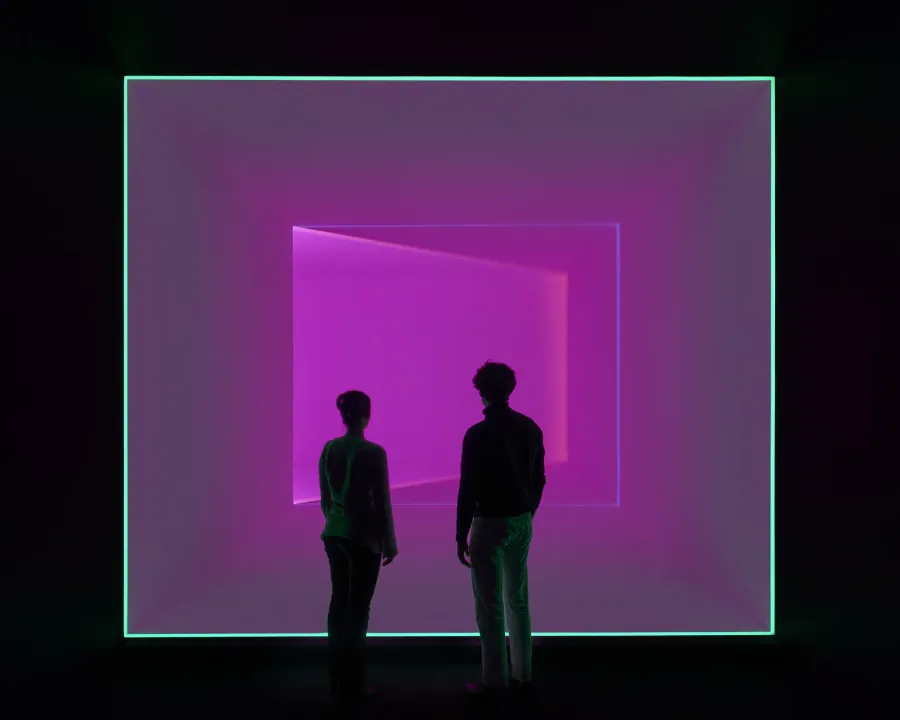
Pace is pleased to present an exhibition of five recent installations by James Turrell—including a new, never-before-seen, site-specific Wedgework made specifically for this presentation—at its Seoul gallery. Spanning all three floors of the gallery, The Return, opening June 14 and running through September 27, will also feature a selection of photographs and works on paper that shed light on the artist’s process for his installations and the construction of his massive Roden Crater project.
The exhibition is accessible by advance reservation only. To schedule your visit, please complete our (opens in a new window)Naver Booking form.
Marking Turrell’s first solo exhibition in Seoul since 2008, this show is organized as part of Pace’s 65th anniversary year celebration, during which the gallery is mounting exhibitions around the world of work by major artists with whom it has maintained decades-long relationships.
Born in Los Angeles in 1943, Turrell is a key member of the California Light and Space movement. He has dedicated his practice to what he has deemed “perceptual art,” working with the materiality of light and space. Influenced by the notion of pure feeling in pictorial art, Turrell’s earliest work focused on the dialectic between constructing light and painting with light, building on the sensorial experience of space, color, and perception. Since his Projection Pieces from the 1960s, his work with light and perception has expanded in various series, including his Skyspaces, which he began creating in 1974, and his Ganzfelds, which he initiated in 1976.
Today, the artist is known worldwide for his immersive installations that, he says, require “seeing yourself seeing.” His work can be found in major museum collections around the globe, including the Museum SAN in Wonju, Korea, which is home to five of his installations; the Bonte Museum on Jeju Island in South Korea; the Chichu Art Museum on Naoshima Island in Japan; the National Gallery of Australia in Canberra; the Museum of Modern Art, MoMA PS1, the Guggenheim Museum, and the Whitney Museum in New York; the Fine Arts Museums of San Francisco; and the Los Angeles County Museum of Art, among many others. With his monumental, ongoing Roden Crater project near Flagstaff, Arizona, Turrell is forging a large-scale artwork and naked-eye observatory within a dormant volcanic cinder cone in the landscape of the Painted Desert of Northern Arizona.
Arne Glimcher, Pace’s Founder and Chairman, first met Turrell some 60 years ago, and the gallery has represented him since 2002. The artist’s upcoming presentation in Seoul—his first ever solo show at Pace’s space in the Korean capital—is an ode to the longevity of his relationship with Glimcher and Pace. The Return will include a new, never-before-exhibited Wedgework installation—in which planes of projected light intersect within a darkened room, lending light a “thingness” through which the room seems to expand beyond its physical limits—made by Turrell this year. Also featured are two large, curved glass installations, a circular glass installation, and a diamond-shaped glass installation. In these pieces from the Glassworks series, shifting planes of light give the illusion of infinite depth. Rarely exhibited together, these Glassworks of different sizes and dimensions will be installed throughout the Seoul gallery, offering visitors a special opportunity to experience the breadth of the artist’s recent work.
The works on paper complementing these installations, which the artist has been producing over the course of his career, speak to the importance of printmaking in Turrell’s practice. At Pace in Seoul, he will show his new series of Wedgework prints, which explore the chromatic variations and formal possibilities of the Wedgework installations. Works related to the artist’s Roden Crater project will also figure prominently in the exhibition, alongside aquatints and woodcuts that depict qualities of light in Turrell’s 2014 installation Aten Reign at the Solomon R. Guggenheim Museum in New York.
The exhibition is accessible by advance reservation only. To schedule your visit, please complete our (opens in a new window)Naver Booking form.
Marking Turrell’s first solo exhibition in Seoul since 2008, this show is organized as part of Pace’s 65th anniversary year celebration, during which the gallery is mounting exhibitions around the world of work by major artists with whom it has maintained decades-long relationships.
Born in Los Angeles in 1943, Turrell is a key member of the California Light and Space movement. He has dedicated his practice to what he has deemed “perceptual art,” working with the materiality of light and space. Influenced by the notion of pure feeling in pictorial art, Turrell’s earliest work focused on the dialectic between constructing light and painting with light, building on the sensorial experience of space, color, and perception. Since his Projection Pieces from the 1960s, his work with light and perception has expanded in various series, including his Skyspaces, which he began creating in 1974, and his Ganzfelds, which he initiated in 1976.
Today, the artist is known worldwide for his immersive installations that, he says, require “seeing yourself seeing.” His work can be found in major museum collections around the globe, including the Museum SAN in Wonju, Korea, which is home to five of his installations; the Bonte Museum on Jeju Island in South Korea; the Chichu Art Museum on Naoshima Island in Japan; the National Gallery of Australia in Canberra; the Museum of Modern Art, MoMA PS1, the Guggenheim Museum, and the Whitney Museum in New York; the Fine Arts Museums of San Francisco; and the Los Angeles County Museum of Art, among many others. With his monumental, ongoing Roden Crater project near Flagstaff, Arizona, Turrell is forging a large-scale artwork and naked-eye observatory within a dormant volcanic cinder cone in the landscape of the Painted Desert of Northern Arizona.
Arne Glimcher, Pace’s Founder and Chairman, first met Turrell some 60 years ago, and the gallery has represented him since 2002. The artist’s upcoming presentation in Seoul—his first ever solo show at Pace’s space in the Korean capital—is an ode to the longevity of his relationship with Glimcher and Pace. The Return will include a new, never-before-exhibited Wedgework installation—in which planes of projected light intersect within a darkened room, lending light a “thingness” through which the room seems to expand beyond its physical limits—made by Turrell this year. Also featured are two large, curved glass installations, a circular glass installation, and a diamond-shaped glass installation. In these pieces from the Glassworks series, shifting planes of light give the illusion of infinite depth. Rarely exhibited together, these Glassworks of different sizes and dimensions will be installed throughout the Seoul gallery, offering visitors a special opportunity to experience the breadth of the artist’s recent work.
The works on paper complementing these installations, which the artist has been producing over the course of his career, speak to the importance of printmaking in Turrell’s practice. At Pace in Seoul, he will show his new series of Wedgework prints, which explore the chromatic variations and formal possibilities of the Wedgework installations. Works related to the artist’s Roden Crater project will also figure prominently in the exhibition, alongside aquatints and woodcuts that depict qualities of light in Turrell’s 2014 installation Aten Reign at the Solomon R. Guggenheim Museum in New York.
| 작가 | James Turrell |
| 전시장 | 페이스갤러리 서울 (Pace Gallery Seoul, ペース・ギャラリー・ソウル) |
| 주소 | 04348 서울 용산구 이태원로 267 페이스갤러리주소 복사하기복사 |
| 오시는 길 | 지하철 6호선 한강진역 1번 출구에서 185m |
| 기간 | 2025.06.14(토) - 09.27(토) |
| 관람시간 | 10:00-18:00 |
| 휴일 | 일요일, 월요일 |
| SNS |   |
| 웹사이트 |